
Costa Rica - January 2025
Pura Vida
For years, we knew we wanted to do something special to celebrate what would have been Ben’s 30th birthday. If you didn’t have the privilege of knowing Ben, he was fun-loving, sought out adventure and empowered others to feel safe doing the same. We wanted this trip to embody his spirit. Costa Rica fit the bill.
Our party of 10 flew in to SJO from EWR, BWI and SFO, and we did our best to coordinate our flights so that we would land around the same time and depart around the same time. Because we were a group of 10, I decided to enlist the help of a travel agency to plan this trip. I was hesitant, after my previous experience with booking with a travel agency for Patagonia, but everything from start to finish was seamless this time around. Our travel consultant, Brandon, with Costa Rican Vacations was very responsive and made planning easy. I had an idea of activities, surveyed our group - keeping in mind the activity level and interests of the group, and of course, Ben.
Day 1: Arrival in Costa Rica - Journey to Chachagua
The NJ group landed at 12:19 PM to a warm welcome—the captain announced it was a balmy 82°F outside and such a joy compared to the January weather to which we had come accustomed. Navigating the airport was straightforward, although we noticed there were no bathrooms between the gate from which we deplaned and immigration on our side. Thankfully, there were facilities on the side the Maryland crew arrived from, located conveniently just before immigration. As we had been told ahead of time by Brandon and his team, there was someone waiting for us before immigration, holding a sign with my name and another sign with someone from the Maryland crew. Angie informed us that they had just landed five minutes prior, and that my sister was already through immigration, waiting for us at baggage claim, and also reminded us of our hotel name, which we would need to know when we speak to the immigration officer.
The line for immigration was quite long, and only got longer after we joined the queue. It seemed like all the flights into Costa Rica arrived at the same time. Selena said that when she got in line an hour or so before us, she had four rows of zigzags; whereas, we must’ve wound our way through at least 3-4 times that many. By the time we got through immigration, duty free (for those purchasing wine for the trip) and collecting our bags, we met Selena at 1:50 PM. We still had to wait a while for the Maryland crew to get through immigration and find their bags. Baggage claim has five or six carousels, and the area between the carousels were lined with bags that had come off and had yet to be claimed - another reason why I think all the flights arrive at the same time. The tour company’s instructions were crystal clear, making our transition seamless despite the waiting time - nothing to be done about that when you arrive on different flights. Friendly staff in bright yellow vests were stationed both before and after immigration, holding signs with our names to ensure easy coordination.
As we exited the baggage claim area, Customs appeared daunting with long lines, but they moved surprisingly fast. Angie accompanied us through customs, outside and across the street to meet our driver, Alex. By 2:40 PM, we were comfortably seated on the bus, refreshed with air conditioning and complimentary water.
Alex spoke excellent English and enriched our drive with fascinating insights. He shared tidbits about the region's geography, noting that the airport and San Jose is situated in a valley surrounded by mountain ranges, and 3 out of 5 million of the country's population lives in this valley. The weather, he explained, is heavily influenced by Caribbean winds, which were strong that day, clearing the skies. On other days, the clouds sit stagnant in between the flanking mountains. We hit quite a bit of traffic on the highway getting out of SJO, where three lanes of traffic funnel down into one lane. Despite getting stuck in traffic, Alex lifted our spirits with freshly made plantain chips bought from street vendors. They were delightfully light and and delicate, and perfectly salty.
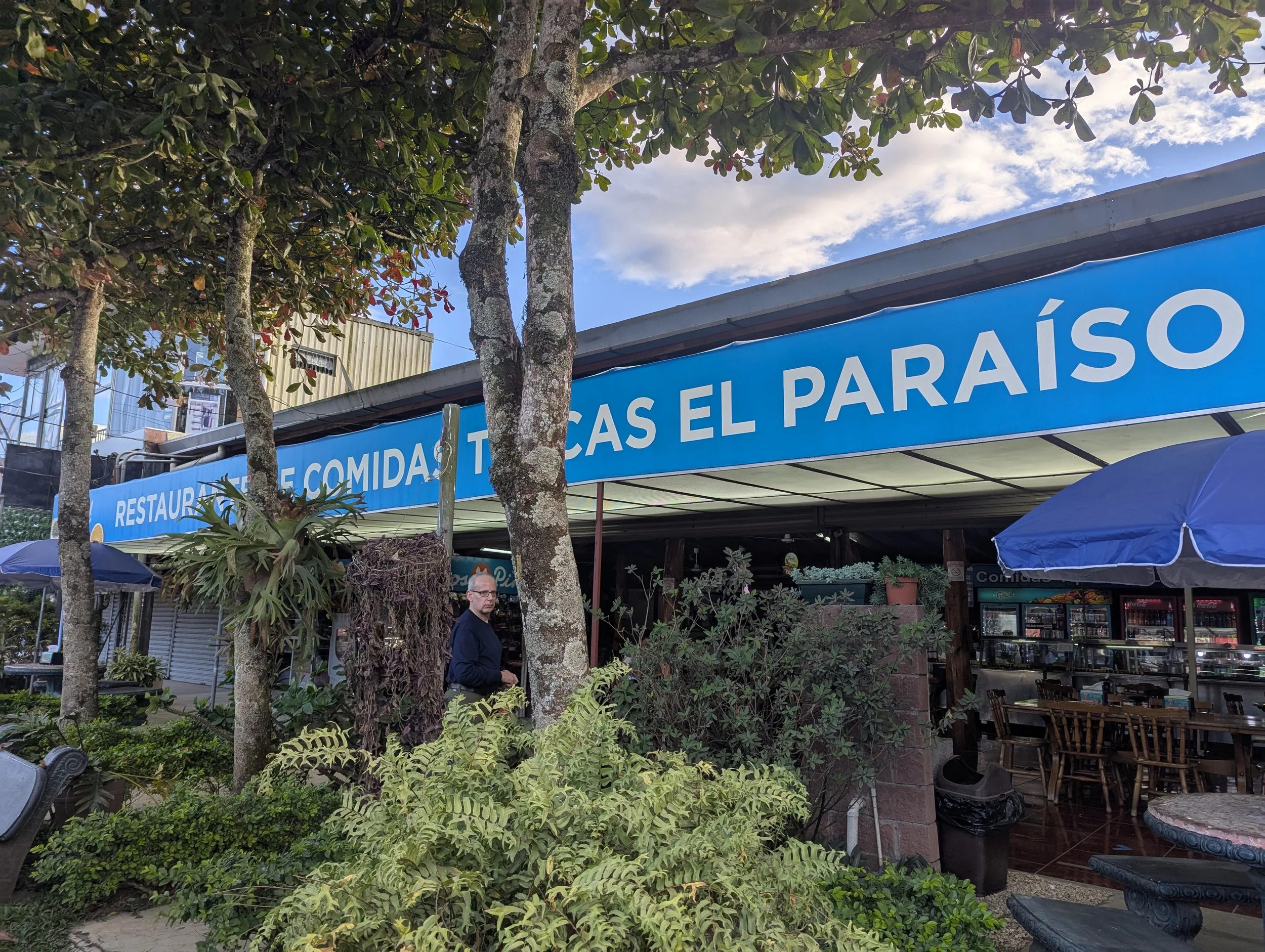
Our first stop was at Restaurante de Comidas Típicas El Paradiso, a cafeteria-style eatery on the side of the road offering an array of traditional dishes. Kevin and I indulged in rice with veggies and chicken (we called it Costa Rican fried rice because that’s what it reminded us of), honey mustard-style chicken wings, black beans, plantains, and a chicken empanada encased in a crispy, fried corn wrapping. Every bite was delicious, a perfect introduction to the local cuisine. The eatery doesn’t look like much from the road, but they have a large seating area to the back that overlooks the natural greenery. Alex informed us that most local dishes aren’t spicy and rarely feature cheese, which is perfect for me! We hit the road again at 5 PM.


The second leg of our journey was through hilly, winding roads—a serious threat for motion sickness. Most of us napped on this leg, perhaps to minimize the risk of getting carsick, perhaps tired from a long day of travel, perhaps as a result of a food coma from our delicious lunch. Alex pointed out sugar cane and coffee plantations, along with greenhouses filled with ornamental tropical plants. Spotting vibrant blue hydrangeas in January was a delightful surprise, even though I know it is their dry season - they don’t have a “summer,” per se. We also passed grand churches, reminders of the country's shifting religious landscape—from a predominantly Catholic populace in Alex's youth to a diverse mix of beliefs today. As the sun set around 5:40 PM, we were surrounded by stunning hills, grazing cows, and an altitude comparable to Arenal’s peak.
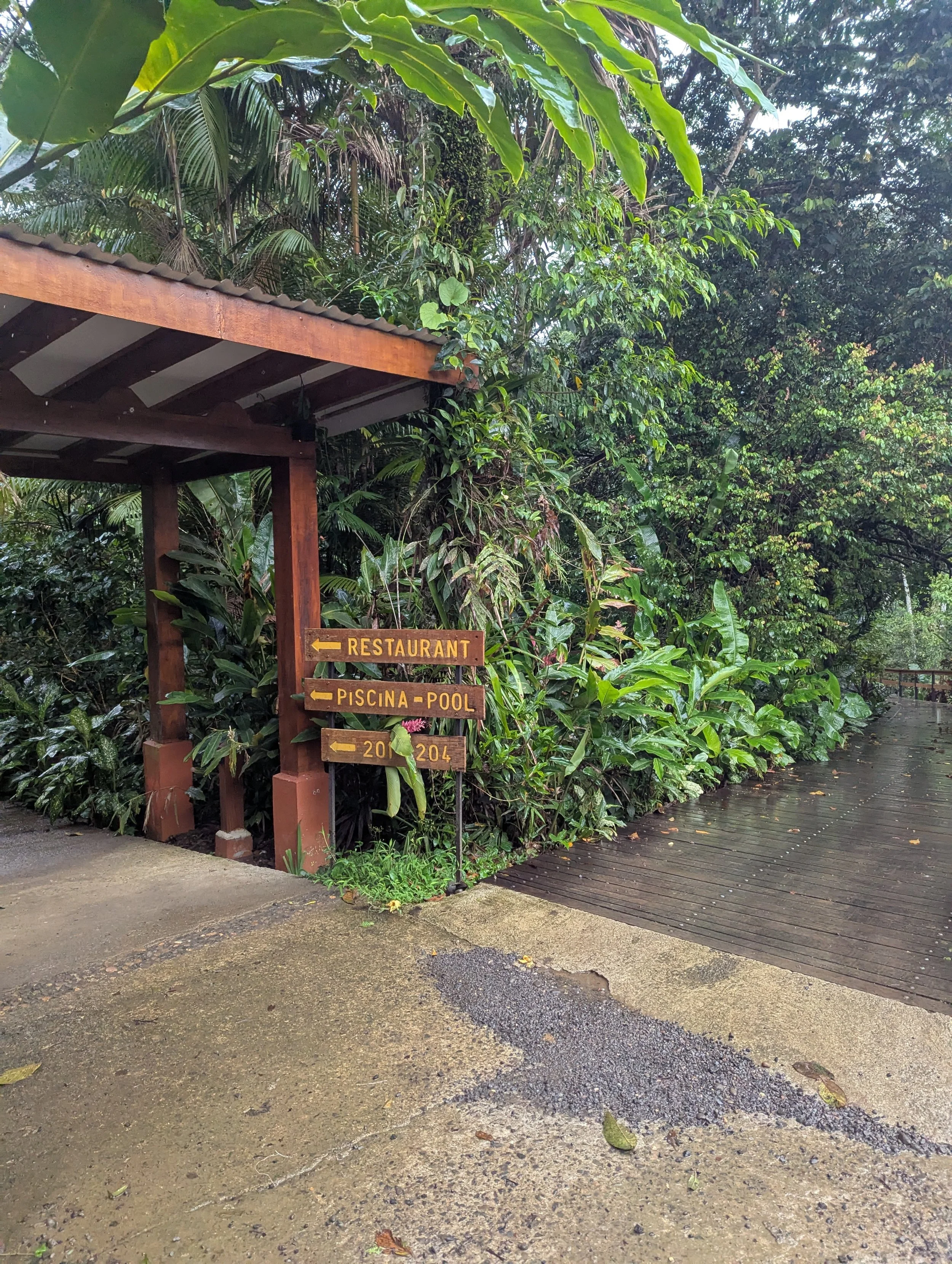
We reached Chachagua Rainforest Hotel at 6:40 PM. Driving up in the dark, winding up a dirt road surrounded by thick jungle, I couldn’t help but feel a little fear and think to myself, “What did I get us into?” I left it all in Brandon’s hands when I was planning the trip. In any case, my reservations lingered as we stepped off the bus to a roofed (but no walls) reception desk. Lorenzo greeted us and escorted us to our villas over a bridge and through the darkness of the rainforest. He had our luggage sent to the villas behind us. By 7 PM, we were settling into our rooms.
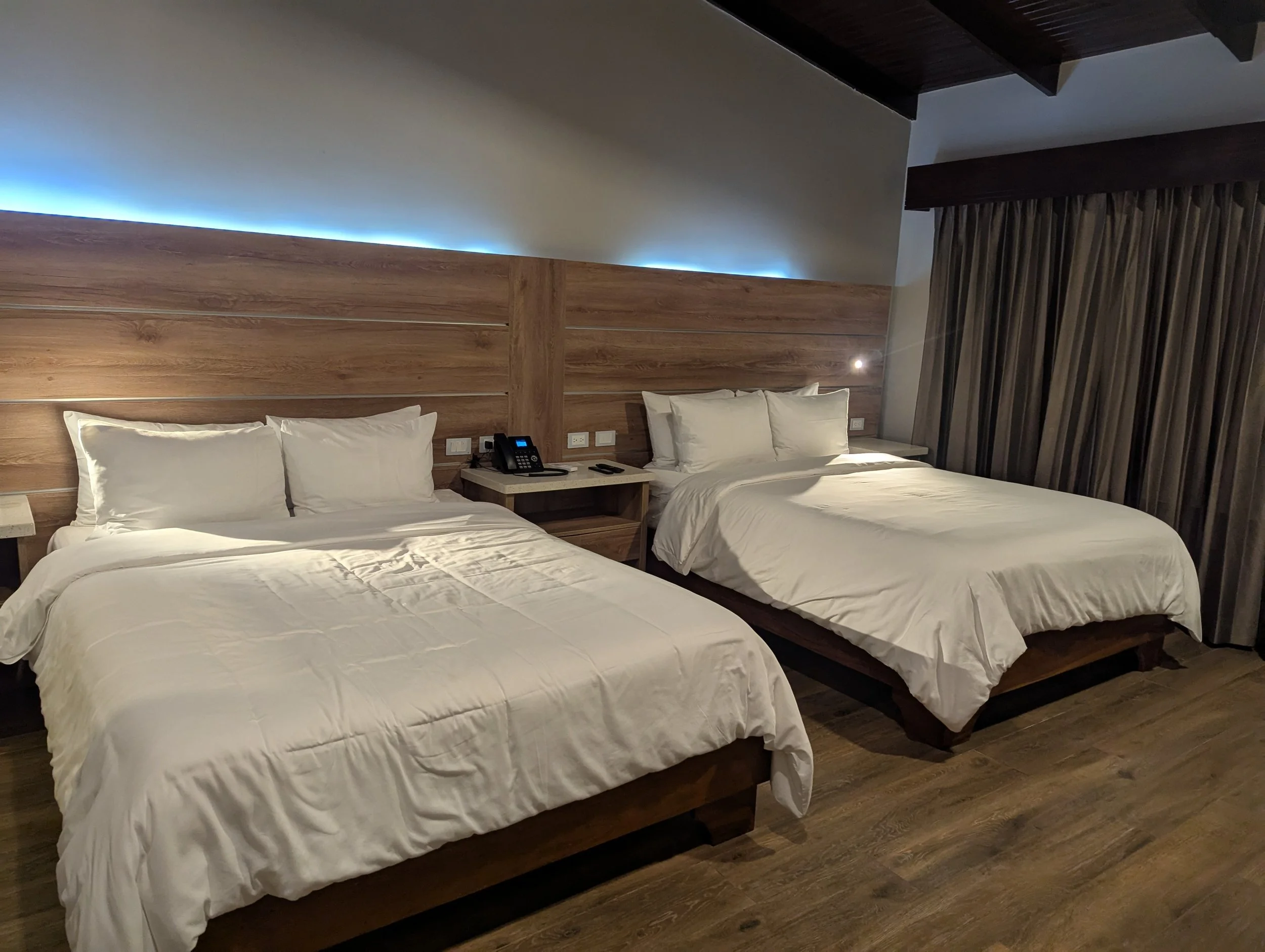
My worries vanished the moment we stepped inside. The villas were exquisite. The rooms themselves were spacious but pretty basic - we were in the middle of the rainforest, after all. One room with a king bed, double vanity, toilet, shower, and access to an outdoor shower; another room with two queen beds, a single vanity, toilet, and shower. The front porch, adorned with rocking chairs, was perfect for morning coffee. The magic was in the backyard - a hammock, a cozy seating area, and best of all, a private pool with chaise lounges amid lush tropical greenery—massive leaves, bird of paradise, ginger plants, and more.


By 7:45 PM, we were settled in. None of us were hungry enough for dinner, given our late lunch. We pre-ordered breakfast at the restaurant, then visited the snack bar to check out the hot springs and menu. Not feeling hungry, we explored the grounds a little and returned to our rooms to prepare for the next day. As 9 PM rolled around, some of us enjoyed a dip in our private pool. Selena called it a night (her long day of travel had started the night before ours) and I read for half an hour before drifting off to sleep at 9:30 PM, content and excited for the adventures ahead.


Day 2: Arenal Hike, Hanging Bridges and La Fortuna Waterfall
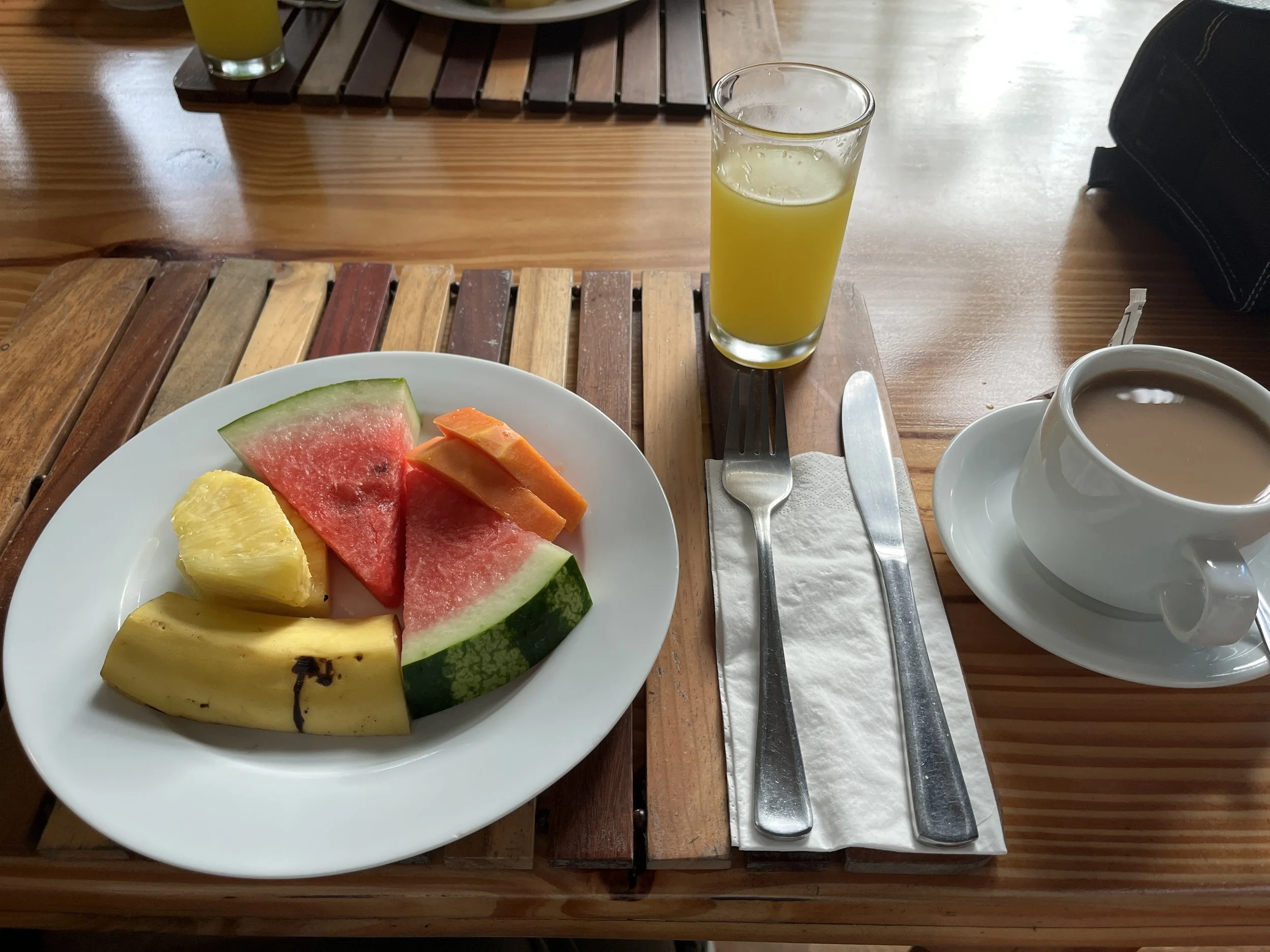
We had an early start with a scheduled pickup at 7 AM. Following Lorenzo's suggestion, we pre-ordered breakfast since service begins at 6:30 AM. Despite our hopes and best intentions, breakfast was served between 6:40-6:50 AM, with Kevin's arriving at 6:55 AM. The meal included coffee, orange juice, and a fresh fruit assortment featuring pineapple, papaya, banana, and watermelon. We hastily scarfed down our food, but got distracted by a yellow-beaked toucan, typically a cloud forest resident, drawn here by recent heavy rains. This species exhibits sexual dimorphism—males have a yellow patch behind the eye, while females display a green patch.


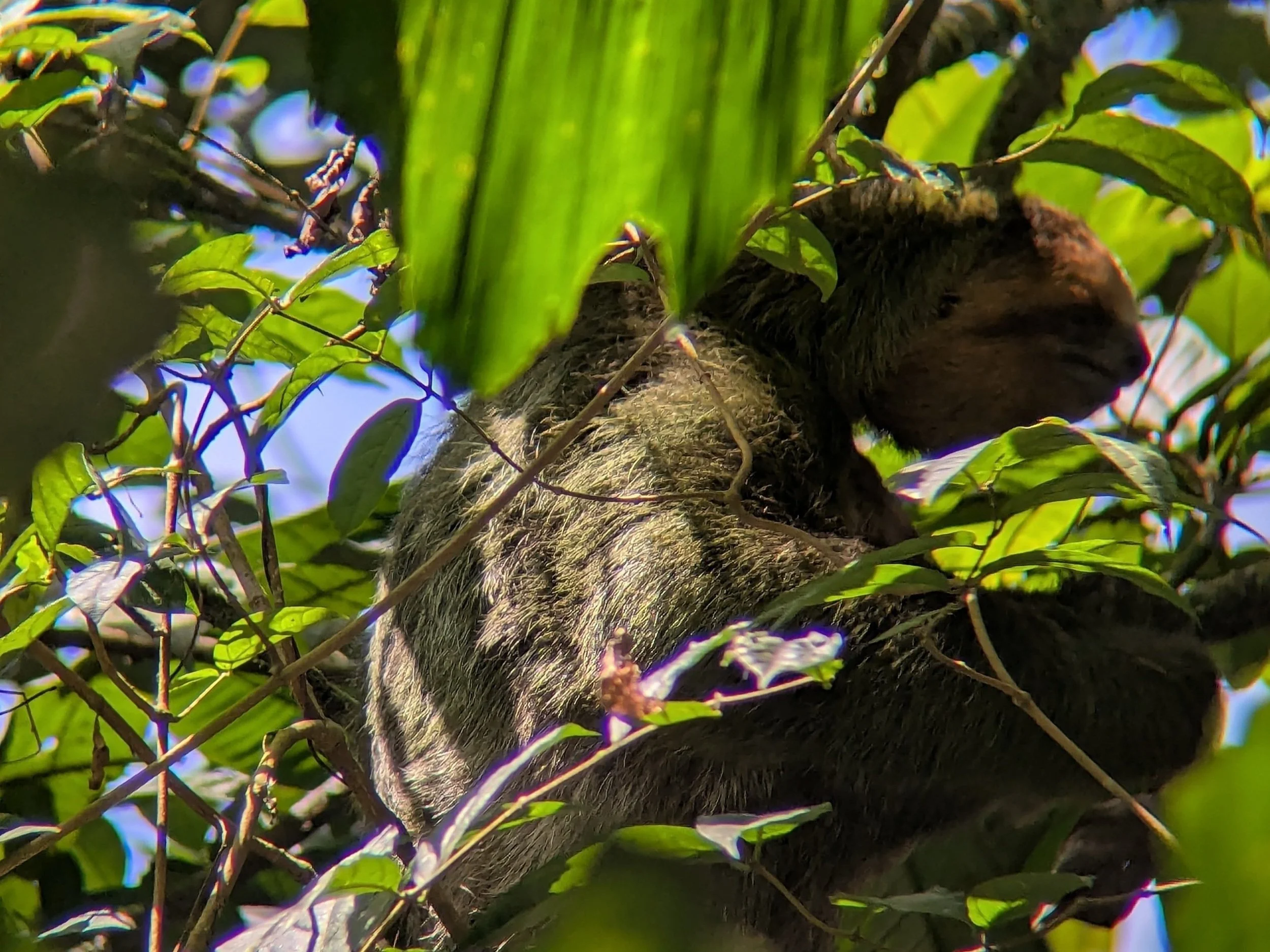
Running a bit late, we met our tour guide, Diego, and driver, Jonathon, from Eco Terra at 7:15 AM. En route to our first activity, Jonathon stopped suddenly in the middle of the road, in front of someone’s house with a chicken coop, and slowly backed up. Diego instructed us to file out of the bus slowly and onto the side of the road. Diego set up his spotting scope on a tripod and directed us to the tree tops. Sure enough, there was a sloth!

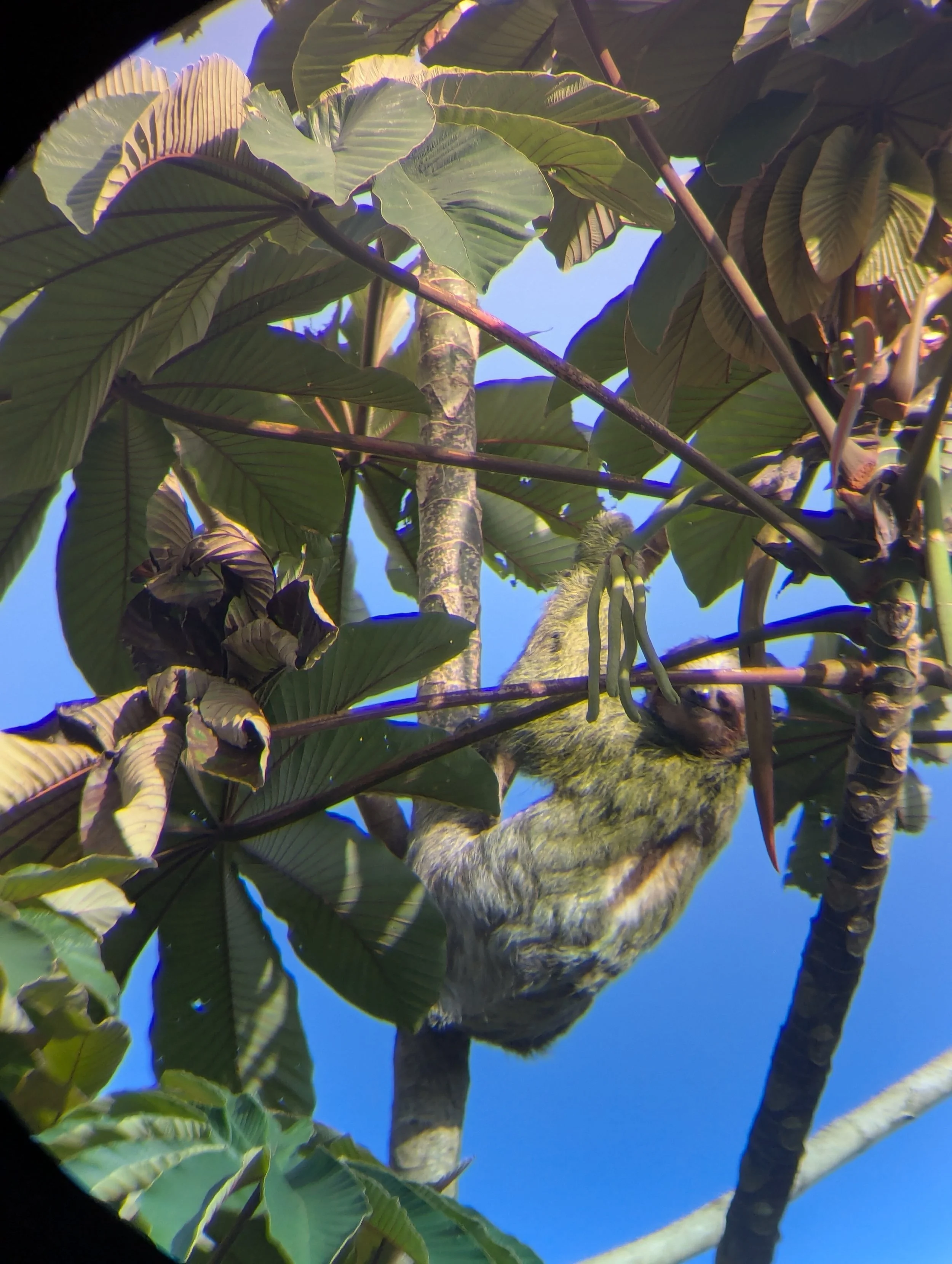

The three-toed sloth spends about 70% of its time munching on trumpet tree leaves. Although their fur is naturally gray, they often appear green due to algae growing on it. This unique algae, found nowhere else in the world, not only tints the sloth’s fur but also gives off a musky scent, providing both visual and olfactory camouflage as a clever defense mechanism. Pythons, which can grow up to 6 meters long, are among the predators that prey on sloths, along with wild cats such as jaguars and pumas. Interestingly, sloths descend from the safety of the trees only once a week to defecate—a behavior scientists believe helps avoid leaving a scent trail that could attract predators. With an incredibly slow metabolism, it takes a sloth 28–30 days to digest a single leaf, and they survive on as little as 140 calories per day. Despite their sluggish lifestyle, sloths can live up to 25 years in the wild.
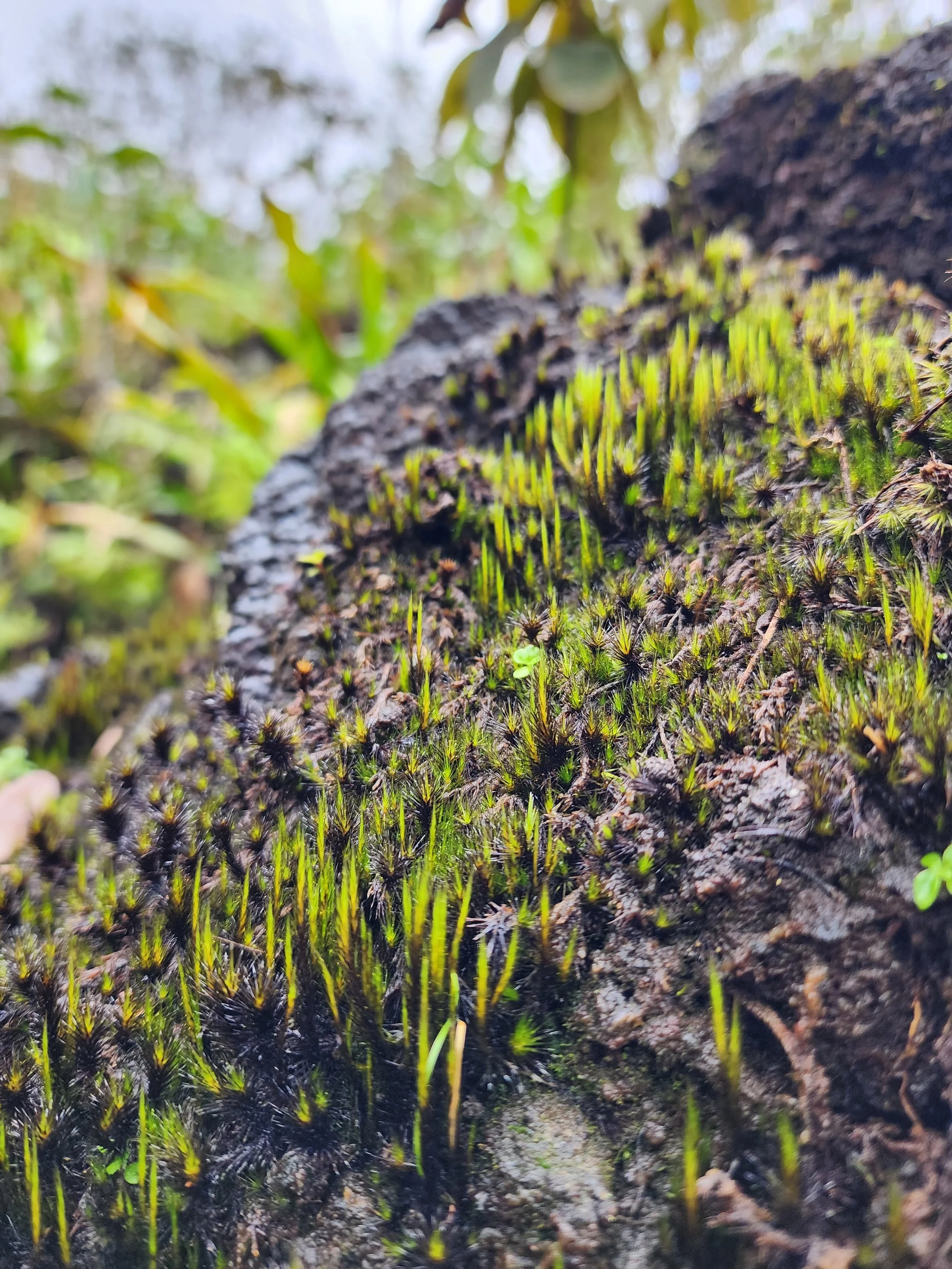
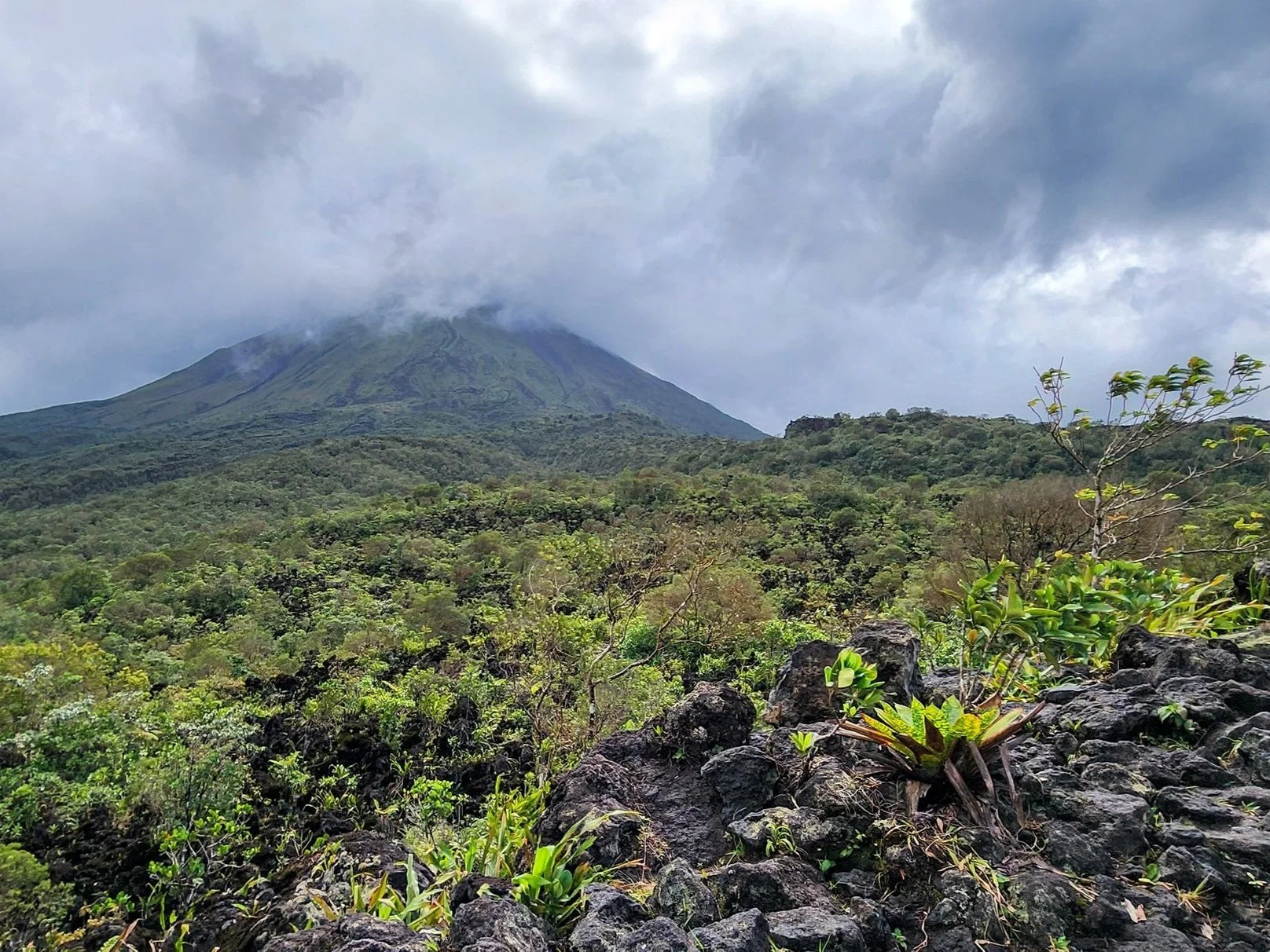
Our first adventure was a volcano hike on private property at El Silencio. Arenal is still considered an active volcano, with its last eruption in 2010. Depending on the source, Costa Rica has five to seven active volcanoes. Arenal is a stratovolcano, formed by layers of volcanic eruptions over thousands of years. Arenal Volcano is completely or partially shrouded in clouds about 80% of the time, as moisture-laden air from the Caribbean gets trapped against the mountain ridges. This results in more rainfall in La Fortuna than in many other parts of the rainforest region. Climbing to the summit of Arenal is illegal, but you can explore trails that wind through the remnants of its recent volcanic activity, offering a fascinating glimpse into the volcano’s dynamic past.
The biggest eruption of Arenal Volcano occurred on July 29, 1968. The main top of the crater was clogged so the magma came down the side and formed three new craters. This catastrophic event destroyed the towns of Tabacón, Pueblo Nuevo, and San Luis, claiming the lives of 87 people, mostly women and children. It occurred at 7AM on a weekday, so the men had already left home to get to the farms for work. The column of ash spewed out at 80-90 miles per hour, the pyroclastic flow, is what killed people, the ash smothering them. The eruption lasted for several days, covering the area with lava, ash, and rocks, and it marked the beginning of Arenal's 42-year period of continuous activity, which lasted until 2010, making it one of the most active volcanoes in the world during that time. This event dramatically reshaped the surrounding landscape, creating new craters and leaving behind the lava fields that visitors can hike today. Today, the region’s natural hot springs serve as a vivid reminder of the volcano’s ongoing geothermal activity. What we see is ecological succession, the environment trying to heal itself.
Our hike started at 8:45 AM. During the hike, we learned about the region's unique flora and fauna. Highlights included sightings of yellow-throated toucans, Aracari toucan, rainbow-beaked toucan - three of six toucan species in Costa Rica), three-toed sloths, iguanas, and howler monkeys. Epiphytes and epiphytism refer to plants that have evolved to grow on other plants, typically trees, without providing any benefit or causing harm to their host, often called the "nurse" plant. Unlike parasites, epiphytes rely on their host solely for physical support, drawing moisture and nutrients from the air, rain, and debris around them. A common example of this are orchids. Throughout our hike, we saw numerous orchids and bromeliads perched on branches of trees.




We concluded the hike at 10:30 AM with a refreshing snack of pineapple, watermelon, and cookies.


Diego informed us that Costa Rica is the biggest exporter of pineapple in the world - and it was so good! Dare I say, even better than the pineapple we had when we were in Hawaii! The top three contributors to the Costa Rican economy are microchips manufacturing, medical supplies manufacturing and tourism.
Next, we visited the Mistico Hanging Bridges around 11 AM. This biodiverse area introduced us to stingless bees, motmot birds, walking palms, and even a tarantula and an eyelash pit viper. The lush rainforest teemed with life, including colorful poison dart frogs and diverse mushroom species.


The park has a large hive for the stingless bees, as they are an indicator of the health of the rainforest. They rely on the diverse plant species of the ecosystem for nectar and pollen, and thus their presence and abundance reflect the overall state of the forest. If the forest is well-preserved and biodiversity is high, stingless bee populations tend to thrive. Conversely, if the rainforest is being degraded or deforested, these bees may vanish or become less numerous, signaling a decline in the ecosystem's health. Their pollination services are vital, as they help in the reproduction of many plants, including fruit trees, medicinal plants, and flowering plants. Without these bees, many species would struggle to propagate, affecting the entire food chain and ecosystem. Stingless bees produce a type of honey that is unique in several ways. Their honey has a more complex, tangy, and sour flavor, due to the different nectar sources they gather, which can vary based on the plants in the area. The honey is also highly prized in traditional medicine for its supposed healing properties, including being an anti-inflammatory, antimicrobial, and antioxidant. They only produce about two pounds of honey per year, making it extremely rare as well.
The motmot, which is actually the national bird of Nicaragua, is known for its vibrant colors and long tail feathers. The tail feathers are used in the mating ritual, but also serve as a defensive mechanism - if attacked and the predator swipes at the bird and hits only its feathers, its body will be unscathed. Motmots also play an important role in controlling insect populations, helping to maintain ecological balance in the areas they inhabit. Their presence serves as a reminder of the beauty and complexity of the tropical forests of Central America.
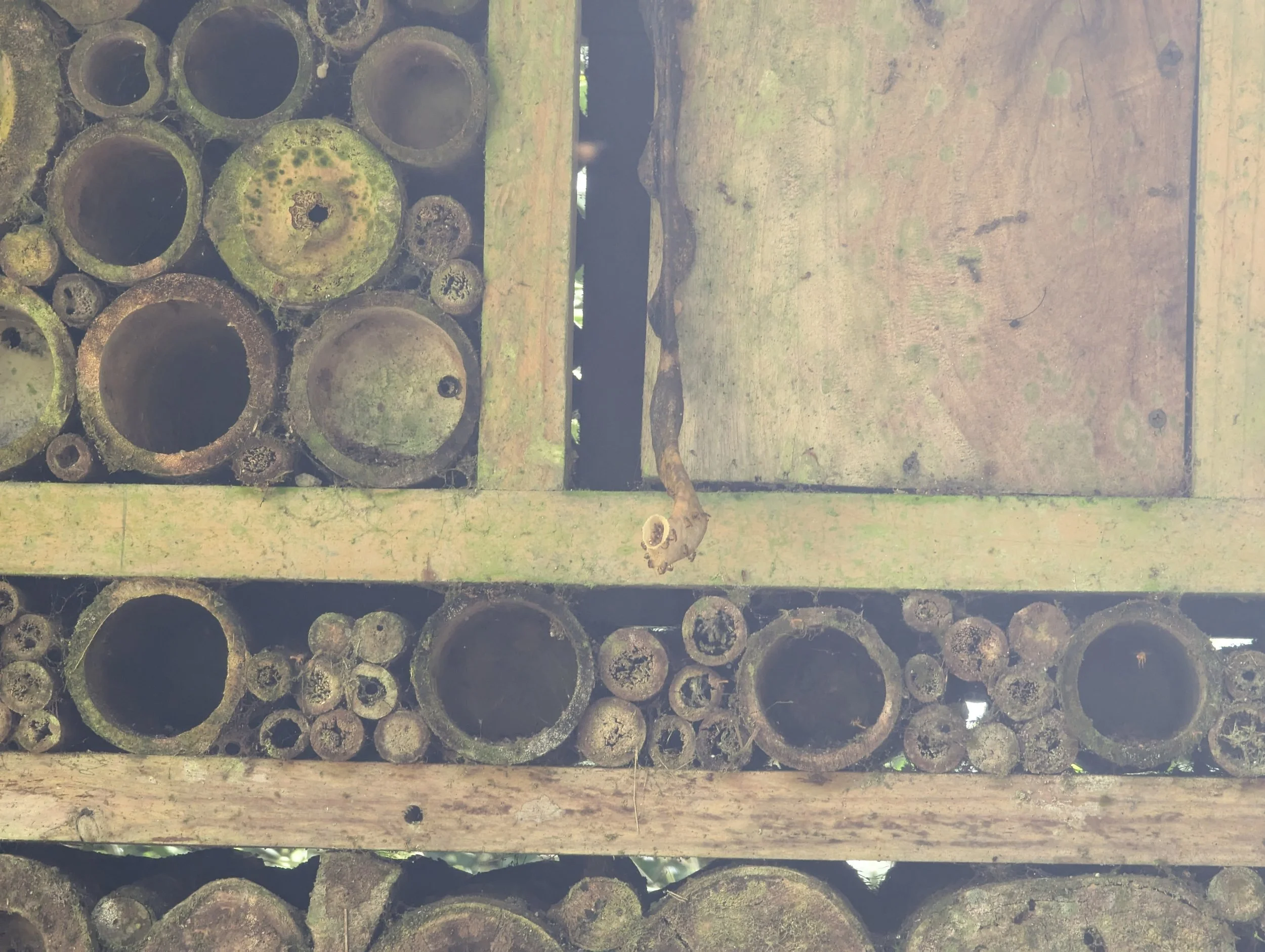


The walking palm tree sprouts a new aerial root when it needs more nutrients or water, and takes on the unique shape of many roots. The trees don’t actually walk or move, but give off the appearance that they do.
The broccoli tree can also be found in Mistico. It has a similar appearance to the trees in Africa. It is not possible to tell the age of trees in Costa Rica. The trees don’t have rings, because they don’t have seasons.
The eyelash pit viper is known for its distinctive appearance, including its characteristic "eyelash" scales above its eyes, which give the snake its name. They are relatively small snakes, typically ranging from 45 to 80 cm (18 to 31 inches) in length, with shades of green, yellow, brown, or even reddish tones, making them highly camouflaged in the rainforest environment. This camouflage helps them hide in trees, shrubs, and leaf litter, where they primarily reside. Eyelash pit vipers are arboreal and nocturnal. The eyelash pit viper is a venomous species, and its bite can be dangerous, though it is rarely fatal to humans due to the snake’s relatively small size and low venom yield. The venom is primarily hemotoxic, meaning it affects blood cells and tissues, causing tissue damage, swelling, and bleeding. However, it is also used by the snake to immobilize and digest prey, often working quickly to immobilize smaller animals. They particularly enjoy hummingbirds and mice. Despite the potency of its venom, the eyelash pit viper is not particularly aggressive and will often try to avoid contact with humans. It relies on its camouflage to remain hidden from predators and threats, only striking if it feels directly threatened or cornered.


Blue jeans, or the strawberry poison dart frog, is named for its vibrant blue legs (like blue jeans) and red body (like a strawberry). Blue jeans is very small, typically growing to about 2 to 3.5 cm (0.8 to 1.4 inches) in length. We didn’t think we would spot one because of how small they are, despite their bright coloration. At the very end of our hike, Diego spotted one for us. Like many other poison dart frogs, the blue jeans poison dart frog produces toxins in its skin that can be harmful to predators. These toxins are called batrachotoxins, which can cause severe reactions in animals that try to eat the frog. However, while the frog's toxins are potent for small predators, they are not typically dangerous to humans unless ingested or absorbed through open wounds. The forests where these frogs live are usually shaded and dense, providing the frogs with plenty of hiding places under leaves and in crevices where they can remain out of sight of potential predators. Blue jeans poison dart frogs are egg layers. The female lays her eggs on the forest floor or on leaves near water. Once the eggs hatch into tadpoles, the male carries them to small pools of water, often in bromeliad plants or tiny puddles. The tadpoles then undergo metamorphosis, turning into juvenile frogs. The male may also help feed the tadpoles by laying unfertilized eggs for them to eat.
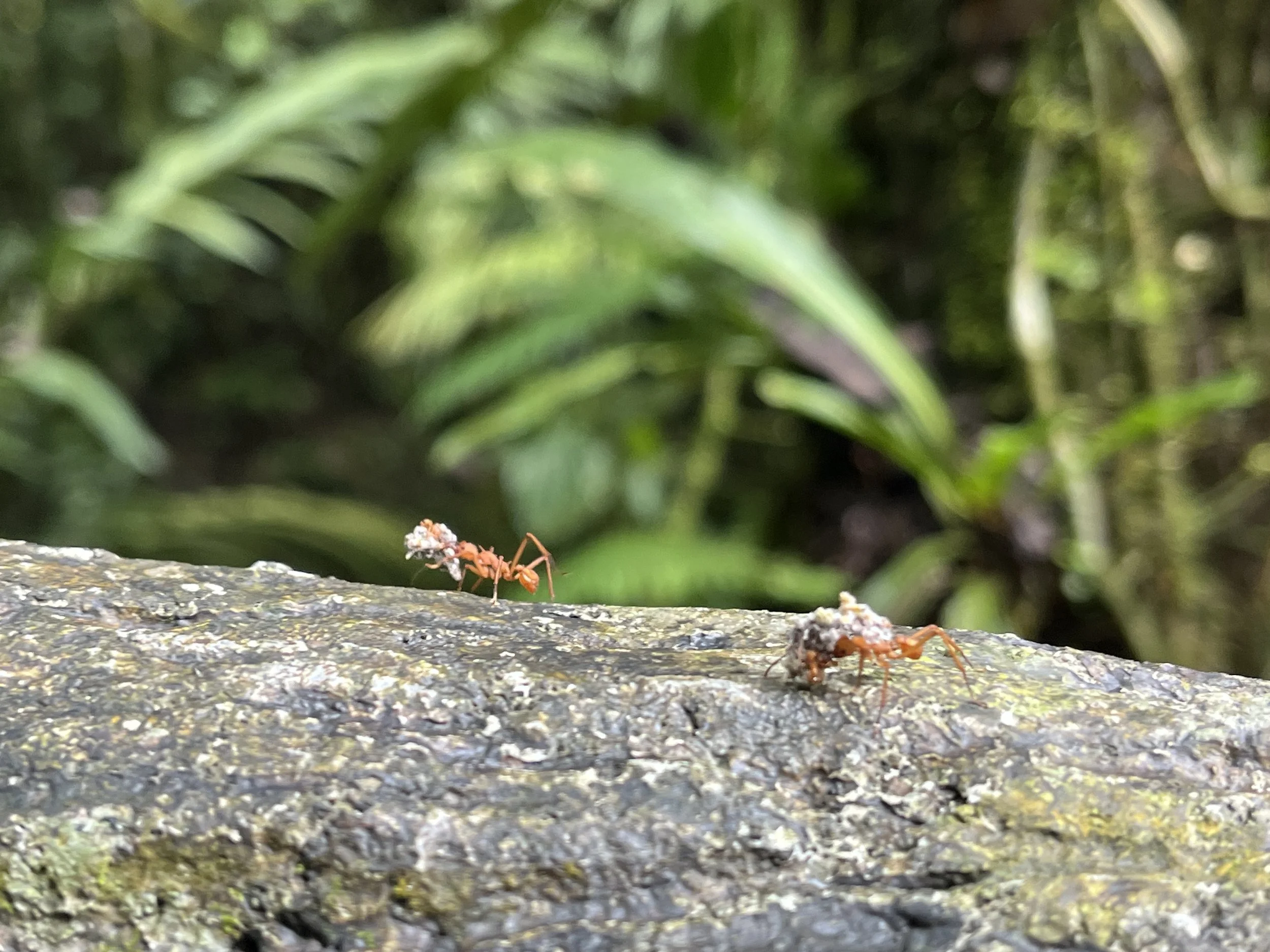
Leaf-cutter ants are one of the most fascinating creatures we saw on our hike and throughout the rest of our trip. They are known for their incredible ability to cut and carry leaves back to their colony. However, they do not eat the leaves directly. Instead, they use the leaves to cultivate a specific type of fungus in underground gardens. The ants cut the leaves into small pieces, which they then use as a substrate for growing this fungus, which serves as their primary food source. This mutualistic relationship with the fungus is what makes leaf cutter ants unique among ants. They can carry 10x their weight. Once they cut the leaves, they carry the pieces back to their nests in a steady stream, forming long lines of ants that can be seen marching along the forest floor. The leaves are carried back to the nest, often covering long distances - we saw evidence of this on the railing along the trail. We saw leaf-cutter ants probably at least once each day.


After a busy morning, we enjoyed lunch at Casa Luna Hotel at 1:40 PM, just as a heavy rain shower began. The meal featured tropical salad or tortilla soup, and traditional casado plates with beef, chicken or fish. The tropical salad had something that looked like an orange cherry tomato but tasted like citrus. Casado is a traditional Costa Rican dish with rice and beans, salad, plantains, tortilla and a protein. Casado means married - back in the day, if a man came to lunch with an elaborate meal as just described, it was an indication he was married; whereas if his lunch was tortillas, it was clear he was single. I had the casado with beef, which I found to be small, thin and tough. Kevin had the fish which was delicious.


We were back on the road at 3 PM, a short ride to our final stop - La Fortuna Waterfall, a stunning 178-foot cascade. As we were about to begin the walk down, it started raining - hard and relentlessly. It is 500 steps down to the base of the waterfall. It was quite a sight! The downpour discouraged us from staying down by the waterfall for too long though, especially knowing that we still needed to climb 500 steps back up! Due to recent rains, swimming was prohibited for safety reasons. According to the guard, swimming hasn’t been allowed since Christmas (for a month) due to the rain and violent conditions around the waterfall. We hiked the 500 steps back up. There is a little cafe and gift shop that we browsed while we waited for the rest of our group to make their way back up. We wrapped up our visit by 3:42 PM.


Our ride home passes the popular Tabacon resort, hot springs and river. Diego warned us that bathing in the river, as so many people do, is incredibly dangerous. People have died, usually resulting from flash floods - the flood itself, or the large debris that quickly comes down the river as a result of the flash food. You’ll see a ton of cars parked along the side of the road here, and read about this on all the travel forums and blogs, but use caution and do as the locals do to keep yourself safe!


We returned to the hotel by 5 PM for some poolside relaxation. We had initially planned a night walk to see nocturnal wildlife, but we discovered it wasn't included in our package like we had originally thought and would cost $50 per person. Instead, we enjoyed a leisurely evening in the pool, ending the day with dinner at 7 PM. Service is slow, especially compared to Northeast standards, but I think that’s part of the Pura Vida charm - to slow down and enjoy the moment, the food, the company. The gang played games in the backyard after dinner, and I turned in at 10 PM, preparing for more adventures ahead.

Day 3: Biking Around Arenal
I woke up naturally at 6:20 AM. Since everyone else was still asleep, I decided to start the morning slowly. The room had an espresso maker, but I didn’t realize how loud and disturbing it’d be until I used it and accidentally woke everyone up - luckily, they are good sleepers and swiftly fell back asleep. I savored my espresso while reading outside, surrounded by lush greenery and the soft rustle of tropical leaves. The backyard of the villa is spectacularly serene and the perfect setting for a peaceful morning.


By 8:45 AM, we headed to breakfast, where we were treated to a lively display of local wildlife. An agouti—a rodent somewhat like a small capybara—made an appearance, along with colorful toucans perched nearby. Dennis, one of the restaurant staff, puts fruit on a tree next to our table to attract the birds, and papaya on the ground for agouti. I enjoyed a hearty plate of sourdough toast topped with poached eggs, creamy avocado, kale, spinach, and sautéed mushrooms. It was the perfect fuel for the day ahead.


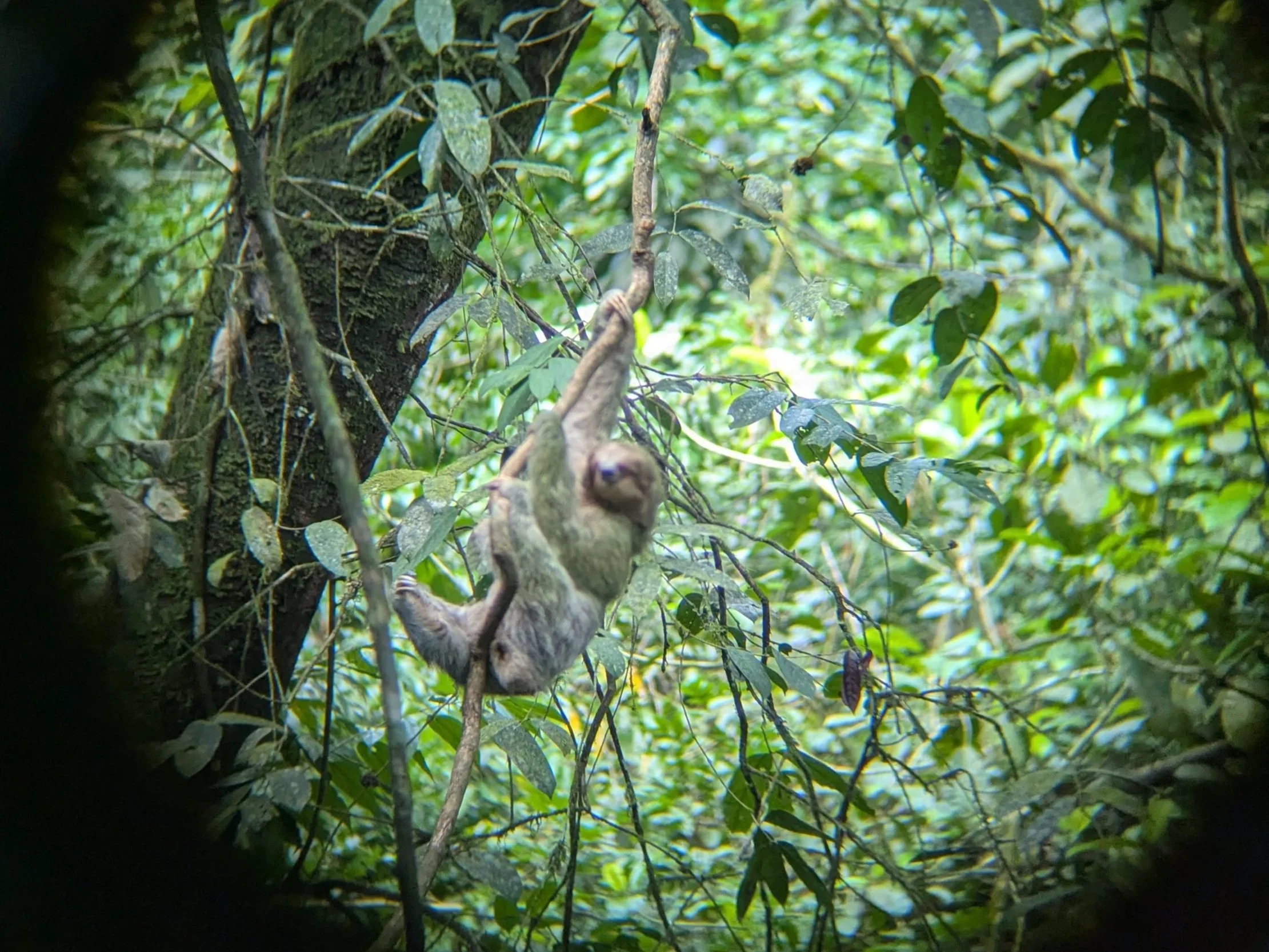
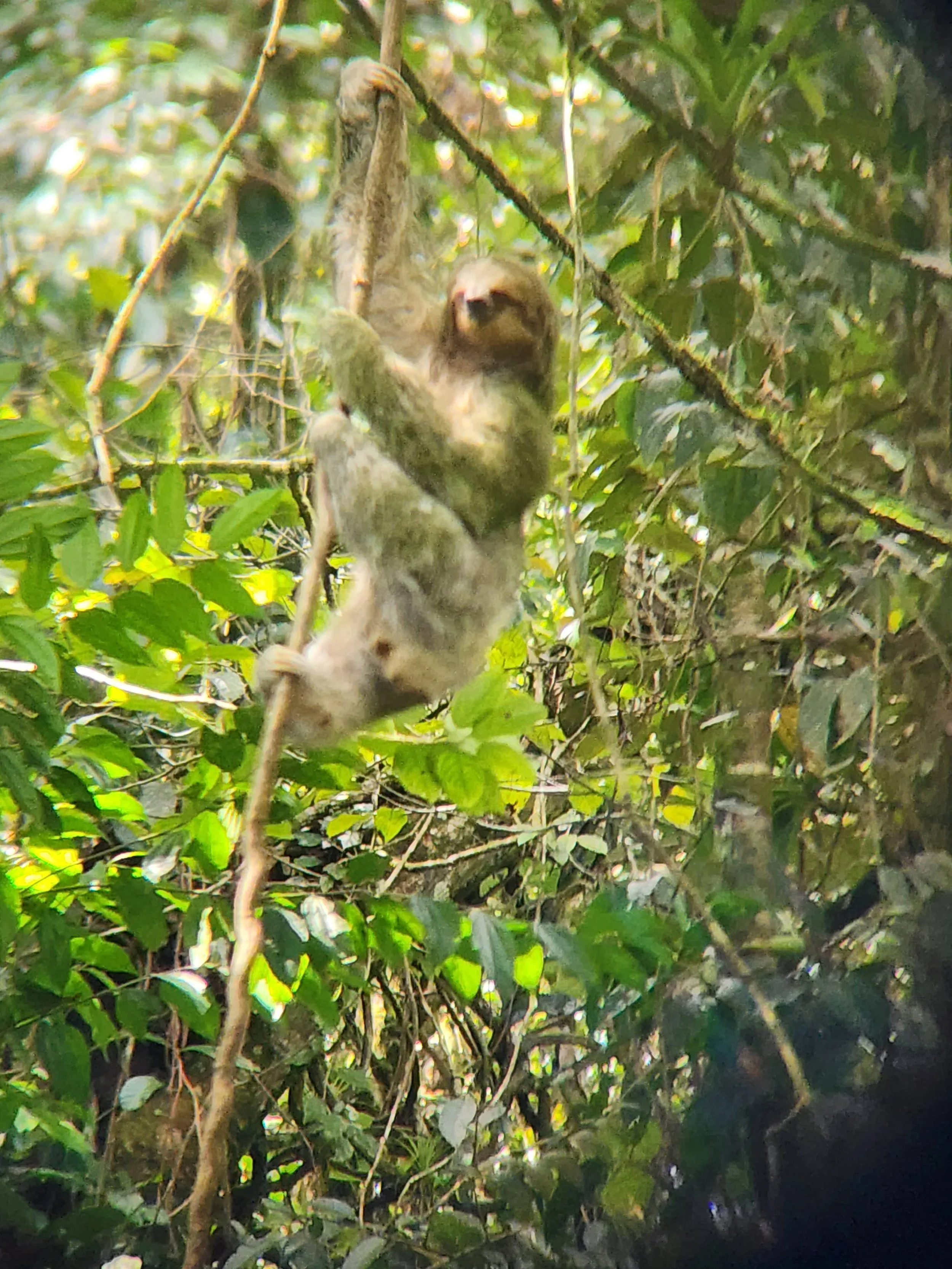
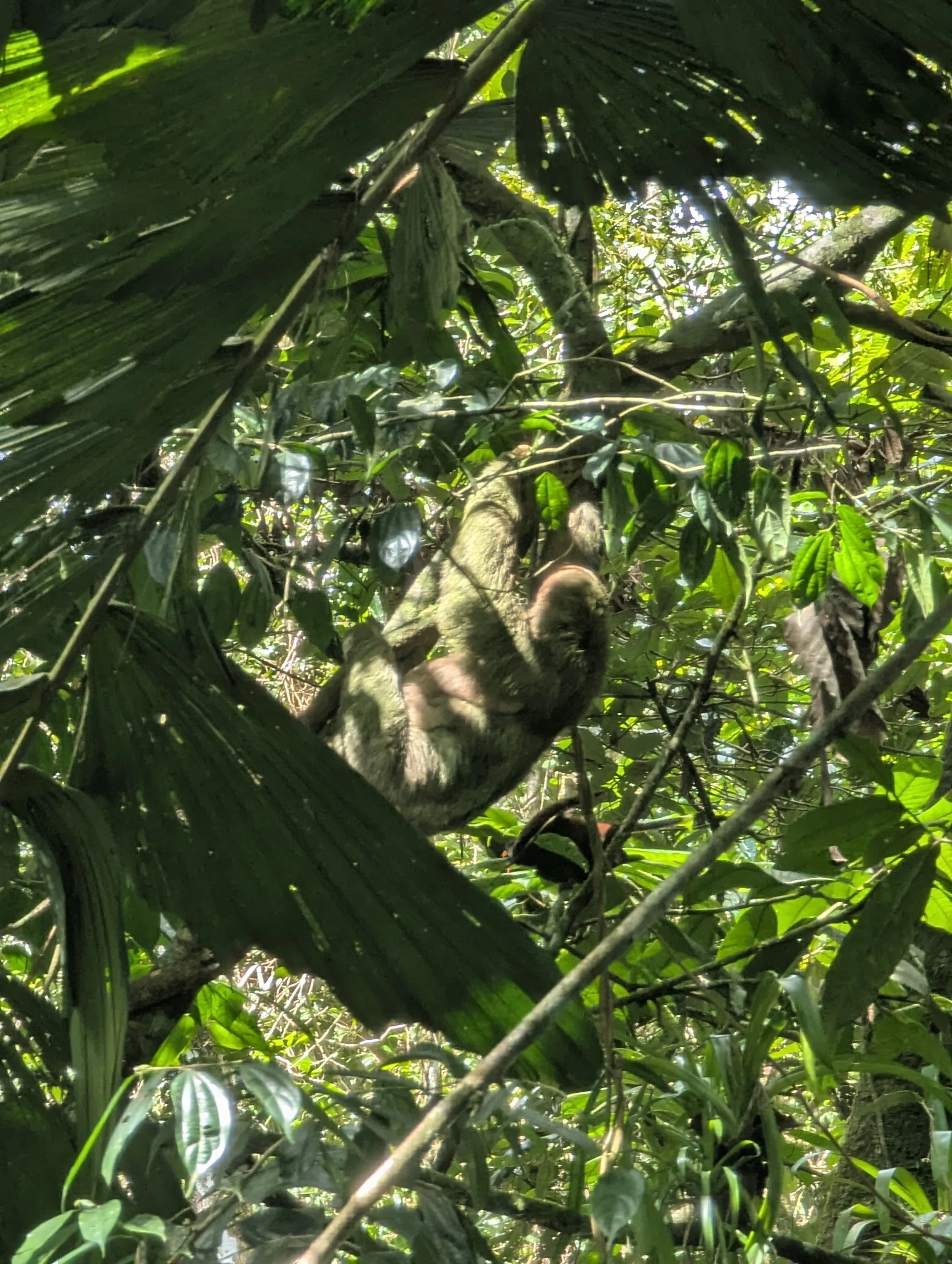
Back in our room after breakfast by 10:00 AM, we soon set off for a hike around the property, determined to visit the majestic Ceiba tree. On our hike, we spotted sloths on the resort property! One was a mama and baby, and the other is definitely a male (from the “speculum” or what looks like a gash down its back) and we suspect was the father. We spent a lot of time admiring them from afar. To be honest, we got a better view of sloths on the resort property than we did anywhere else on the trip!



We reached it at 11:18 AM, awed by its towering presence. The ceiba tree (Ceiba pentandra), also known as the kapok tree, is one of the most iconic and majestic trees, and one of the tallest trees in the rainforest, capable of reaching heights of 60 to 70 meters (200 to 230 feet) with a trunk diameter that can exceed 3 meters (10 feet). The base of the trunk is broad and smooth, and reminds me of a shoulder blade. The ceiba tree is, growing rapidly due to its soft, lightweight wood. While this makes it useful for construction—leading to widespread logging by companies—its true value goes far beyond timber. In ancient times, the ceiba was revered as a sacred connection between the earth and the spiritual realm, believed to link humans with the gods. Its towering canopy provides a vital home for diverse wildlife.
The mighty harpy eagle, one of the world’s largest and most powerful birds, often nests at the very top of the ceiba tree. This apex predator preys on sloths and monkeys, even capable of carrying off young children with ease. Sadly, because it was once hunted to protect livestock and children, the harpy eagle is now endangered. The ceiba is also host to fascinating creatures like the ceiba beetle, a massive insect roughly the size of a smartphone. These beetles bore large holes into the tree’s trunk, creating pathways where they harvest worms and other small invertebrates. More than just a tree, the ceiba is a towering symbol of life, spirituality, and the delicate balance of rainforest ecosystems.
The hike, a 1.3-mile loop, offered beautiful views and a refreshing connection with nature. Along the way, we spotted a heron and a family of turtles. We returned from our short hike around 11:45 AM, spending some time relaxing, drying out our shoes from the previous day's torrential rainfall adventures, and, for me, finishing my book.


At 1:00 PM, Cesar and David from Jacamar Tours picked us up. We arrived at our starting point around 2:15 PM. Jorge had all our bikes laid out ready to go. We hopped on to make sure they were working fine and to get used to the gear changers. By 2:30 PM, we were pedaling our way around Arenal Lake. The 16-mile round trip offered stunning views and a refreshing breeze. This excursion really focused on the biking, and significantly less so on the culture and wildlife. In my personal opinion, it felt rushed. Arenal Lake is so beautiful, especially with Arenal Volcano towering above it, and it felt like we didn’t get enough time to take it in. We stopped only a couple times on the way out, to make sure everybody could catch up, not to learn about anything or explore off the road. While the road around the lake continues to surround the lake completely, we stopped at a river that would otherwise require a 4x4 truck to cross. We spent some time here before turning back the way we came.
Arenal Lake, spanning 50 square miles, plays a crucial role in Costa Rica's energy production, generating 20–30% of the country’s electricity through hydroelectric power. To maintain its optimal capacity, water from the lake is regularly drained into the Arenal River, which flows toward the drier western regions of the country. This area is particularly vulnerable to drought during the dry season, making the lake’s water management essential for both energy and environmental balance.


Along the route, we spotted a howler monkey lazily perched in the trees. Cesar pointed them out on a tree above the road as he continued pedaling past. Craig made such a sudden stop he almost flipped over his bike! We did not have the opportunity to hear the howler monkeys call to each other, but I hear they sound like dinosaurs.
Midway back to the starting point, we paused for a snack of fresh pineapple and watermelon that our driver, David had prepared for us.


After we reached the meetup point, we boarded the bus for our return trip home. On the bus, Cesar talked about local wildlife: rivers flowing to the Caribbean are home to shy crocodiles that can reach up to 15 feet, while the Pacific rivers host more aggressive ones. Herons eat baby crocodiles. We also learned about caimans, which grow up to six feet and are notably calm around humans. Costa Rica boasts four monkey species: howler, spider, capuchin (white-faced and incredibly intelligent), and squirrel monkeys. Green and red macaws add vibrant splashes of color to the canopy. The Great Green Macaw prefers the Caribbean side, whereas the Scarlet Macaw prefers the Pacific side. Both the green and red macaws are now endangered due to deforestation. We learned that 60% of Costa Rica's forests were once cut down, leaving only patches of primary forests untouched by human activity.
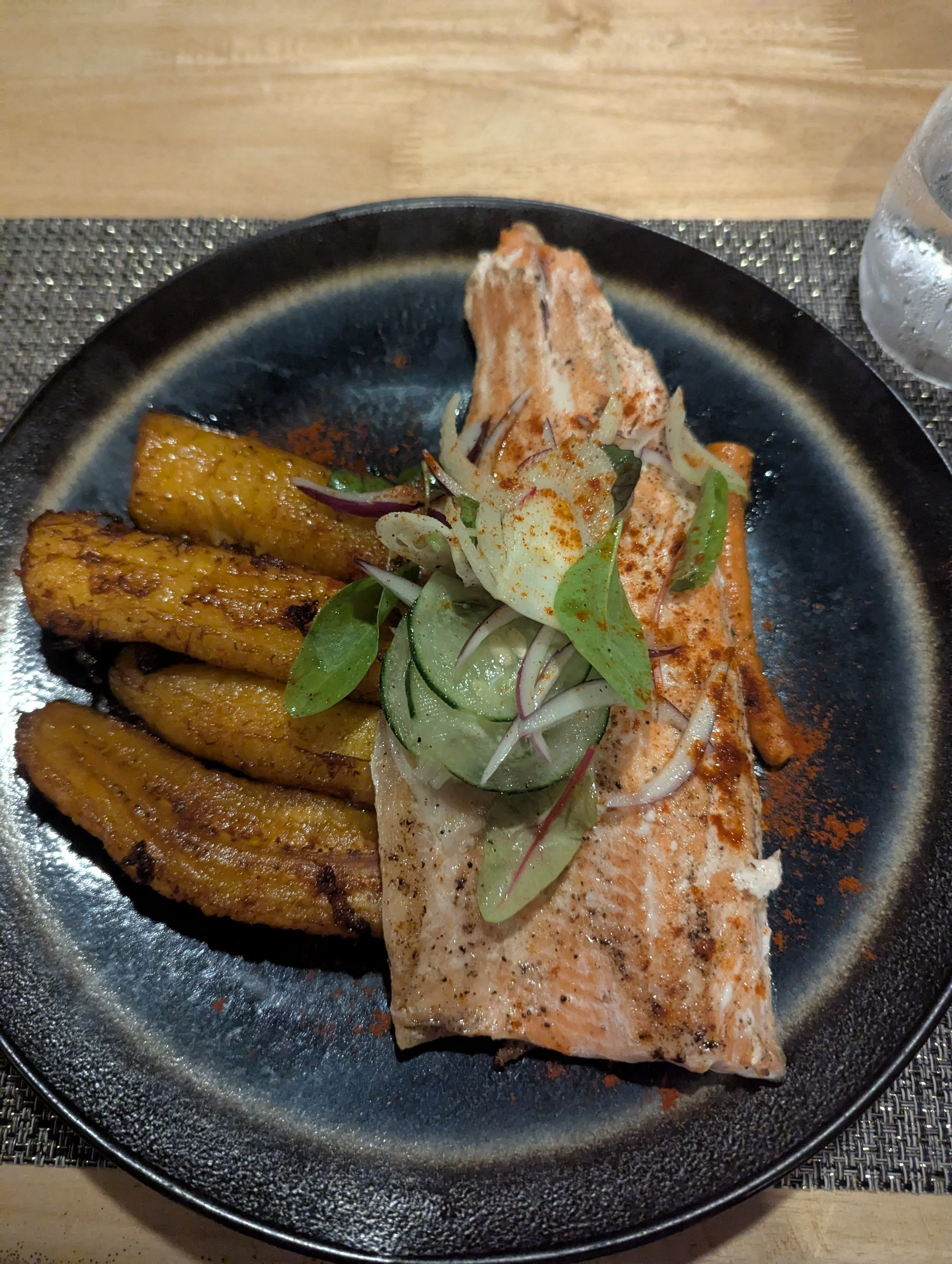
After returning at 5:35 PM, we quickly freshened up for our 6:00 PM dinner reservation. We started with hummingbird ceviche (don’t worry, it doesn’t actually contain hummingbird) and octopus with squash—each appetizer bursting with fresh flavors. For my main course, I had glazed corvina with asparagus and plantains, while Kevin enjoyed a rich mussel ragu with jumbo shrimp in a creamy sauce.
Back at our room by 7:45 PM, Selena joined her Japanese class online while we headed to the pool for a relaxing soak. I came in around 8:30 PM to shower and read, winding down after an adventure-filled day. Lights out by 9:40 PM.
Day 4: From the Rainforest to the Beach
I woke naturally at 6:30 AM, savoring the peaceful start to my day. After some quiet reading outside, I finished packing up and brewed a fresh cup of coffee around 7:30, this time waiting until everyone was awake after learning how loud the espresso machine is. At 8:00, we headed to breakfast where I enjoyed a delicious Eggs Benedict. On our way back, we had the delightful surprise of spotting a sloth and her baby in a tree, thanks to some fellow travelers who pointed them out to us.


Our departure for the next leg of our trip was scheduled for 10:25 AM with Manrique from Jacamar. The journey took us along very windy roads, which was challenging for those prone to carsickness. The ride to Manuel Antonio is estimated to be four and a half hours on Google Maps.
At 1:10 PM, we made a stop at El Jardín in Orotina for lunch, a bustling tourist spot featuring xylophone players at the entrance. They offered free coffee and chocolate samples, along with convenient restrooms and a cafeteria. Lunch for Kevin and me cost 22,000 CRC (about $45), and included Costa Rican fried rice, salad, beans, fish, pork, and plantains. It was clearly very touristy and probably wouldn’t be on my list to return to again. My uncle said that they had stopped at this very place on his world cruise when they were in Costa Rica.
We were back on the road by 2:20 PM, arriving at Los Altos Resort around 4:15 PM. It was 84 degrees in Manuel Antonio. Our concierge, Alex, gave us a tour of our penthouse, stalling for time since one of our rooms wasn’t ready. The connecting doors between our suites were not working our entire stay, and the elevator doors would open either to side A or B, but not both at the same time, so we had to go up separately. Our penthouse, Suite 28B, had three bedrooms on the main floor (only two were available due to the number of people staying) and a huge master upstairs. We had rooftop access with a hot tub. There is a private beach on-site that closes at 6 PM, with complimentary transportation to and from, and the pool closes at 7 PM. The hotel communicates via WhatsApp, making it easy to arrange reservations and transportation. They also offer complimentary guided hikes at 3:30 PM daily, as well as cooking classes and yoga sessions.


By the time all our rooms were ready, it was 5:30 PM. We did some research for dinner, caught a stunning sunset from our rooftop, and changed to head to the pool. It was a short downhill walk on a paver walkway (with working leaf-cutter ants!), less than five minutes. The infinity pool, with two hot tubs overlooking the ocean, was breathtaking. As the sun had set and the pool lights glimmered, it felt magical. We returned at 6:30 to get ready for dinner.
When we were checking in, Alex highly recommended a guided tour through Manuel Antonio National Park. We had booked all of our excursions ahead of time with the travel company. Alex efficiently rescheduled our zip-lining adventure to 2 PM instead of 11 AM and arranged for a guide to pick us up at 7:30 AM to explore the park. The four-hour guided tour, including transportation, was $60 per person. The park closes at 3:30 PM, is closed on Tuesdays, and visitors are not allowed to bring plastic of any sort or food, only reusable water bottles.
The hotel staff recommended Oceano Restaurant and arranged taxis for us. The short ride cost $10 and $14, respectively, for about a three minute ride. Our 7:30 PM reservation turned into a heartfelt evening as we celebrated Ben’s 30th birthday, shared stories, and cried together. Selena and I reminisced about our separate trips we had with just Ben - Selena and Ben had gone to Acadia, and Ben and I had gone to the Smoky Mountains in 2017. He brought us out of our comfort zone and made us feel safe. For both of us, it was the first time we hiked in the dark, and it felt like no big deal because he was there. For me, Ben and I had hiked up to Mount Le Conte and caught golden hour and sunset at the summit. There are cabins up there and we walked about someday returning and staying in a cabin. We hiked down in the dark, with only the guide of his red headlamp, and he would periodically call out “wooo-wee!” to keep bears away.
We finished dinner around 9:30 PM and enjoyed an easy 15-minute walk back to the hotel. Sweaty but content, we went to bed at 10:45 PM, looking forward to our next adventure.
Day 5: Manuel Antonio National Park and Ziplining
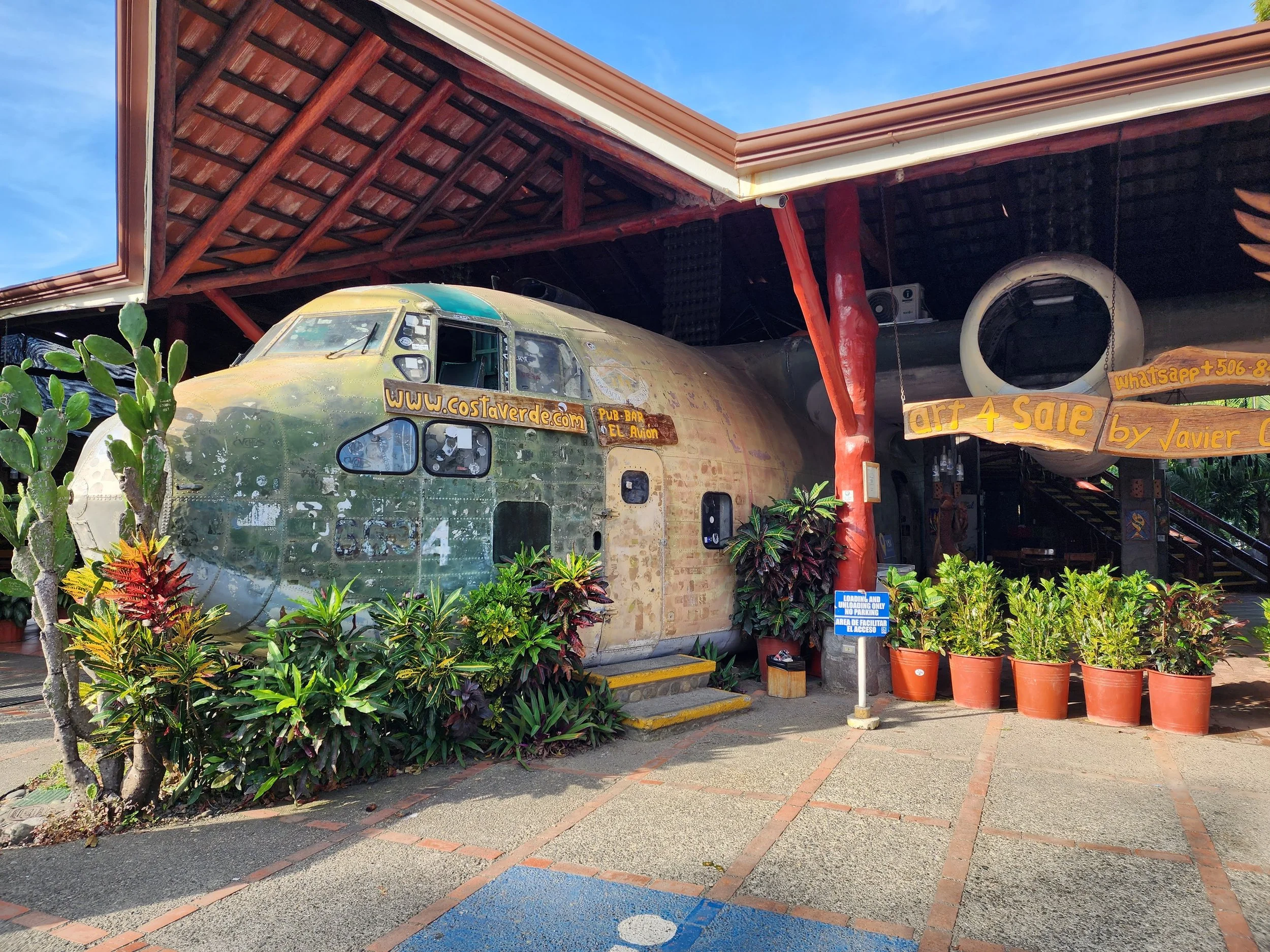
We woke up early at 5:50 AM to prepare for the day ahead. We had breakfast at the restaurant on property at 6:30. Our pickup was at 7:35 AM with Alessandro, our guide from Epic Adventures, and our driver, Moses. Before heading into Manuel Antonio National Park, we made a quick stop at El Avion, a restaurant down the road from our hotel, while waiting for the rest of our group, who never came. By 7:50 AM, we were in line to enter the park, which was already bustling with early visitors. (Pro tip: the park is closed on Tuesdays; Mondays and Wednesdays are extra busy as a result.)
Manuel Antonio is a haven for wildlife, thanks to its natural ecosystem. The park and surrounding areas have plenty of bats and dragonflies, which keep mosquito populations surprisingly low. We spotted a yellow-throated toucan feasting on Panama tree fruit just after we entered the park. Costa Rica has six species of toucans, and Manuel Antonio is home to two: the yellow-throated toucan and the fiery-billed aracari.
One of the highlights was seeing a two-toed sloth, which differs from its three-toed cousin. Two-toed sloths are nocturnal, lack algae on their fur, and are omnivores, feeding on insects, flowers, leaves, and even small birds at night. Sloths rely on their sharp nails as their primary defense. Despite their slow reputation, the toe-toed sloths can be surprisingly quick when it comes to fighting—especially over mates. Males use their claws to slash at rivals, attempting to knock them from the trees. Interestingly, a sloth that loses a fight will avoid climbing that same tree again, opting to find a new one instead. During mating season, which is currently underway, sloths are quite active, often mating multiple times a day. After birth, the baby stays with its mother for 6 to 7 months, clinging to her as it grows and learns. We also learned that three-toed sloths eat a toxic leaf from the Cecropia tree, which contributes to their slow, lethargic behavior—hence the nickname, the "Bob Marley tree."
Fascinating Sloth Facts:
Sloths come down from trees to poop, digging small holes and covering them with leaves to avoid attracting predators. They do not pee - like birds, their excrement is combined
They don’t drink water directly; instead, they absorb it from leaves and fruits
Sloths have four stomachs
They can live up to 21 years in the wild
Sloths weigh 4-5kg. Interestingly, 50% of their body weight is fur, which houses beetles that help clean their skin. The beetles lay their eggs on sloth poop
The main predators of sloths are ocelot, puma, jaguar (not in Manuel Antonio) and the harpy eagle
Alessandro told us that there are more than 3,000 types of butterflies in Costa Rica. The blue morpho being the one that stands out (read on to learn more). There are 52 species of hummingbirds. Hummingbirds flap their wings 50-80 times per second, giving them the ability to hover in place. There are 935 species of birds in Costa Rica, which is #2 in Central America, after Colombia which has over 1,000 species of birds.
We spotted a Jesus Christ lizard, named because of its remarkable ability to walk on water. It can sprint across the surface of ponds, rivers, and streams thanks to its long toes with fringe-like scales that create air pockets, increasing surface tension. They slap the water hard with each step, generating enough lift to support their lightweight bodies. This fascinating skill helps it escape predators quickly, especially when startled. Unfortunately, we did not get to see the Jesus Christ lizard in action - this one was just chilling on a log in a little pond.
We also spotted a baby fer-de-lance pit viper, the second most venomous snake in Costa Rica after the bushmaster. It was camouflaged under dry leaves, just six inches long but highly dangerous. Baby vipers are more venomous because they lack control over venom release, so they operate by an all or nothing protocol and release all their venom when they attack. Fortunately, antivenom is available, though it’s crucial to get treatment within 3-4 hours of a bite from a fer-de-lance pit viper.


By 10:30 AM, we reached Manuel Antonio Beach, one of the most beautiful beaches in the country. We enjoyed some downtime at the beach for half an hour, bathing in the warm Pacific water. At 11, we started the 35 minute walk back to the park entrance and to the bus. Epic Adventures provided us with fresh fruit and water, which was a refreshing treat. We returned to the hotel by 11:45 AM for a quick shower, after being in the humid jungle all morning. We had a quick lunch at Emilio’s Cafe at 12:30 PM. I had a delicious falafel pita while soaking in the beautiful view overlooking the ocean. A few people in our group had the fish curry and seafood curry, which they said was surprisingly good.


In the afternoon, we embarked on a zip-lining adventure at Sukia Park with guides Brian, Juan, Lester, and Manny. We were picked up at 1:40, but we could have easily walked to the park, had we known it was so close! There were nine zip lines and one rappel. We even had the opportunity to do one zipline upside down! The guides were fantastic, laidback and funny. Sukia Park also has a butterfly garden and crocodile lagoon, and they offer jungle tours and a night walk. They are working on installing a snake pit and frog sanctuary as well. The butterfly garden and crocodile lagoon were included in our zipline tickets, but our guides told us the animals are more active in the morning. They offered that we could return the next morning for free instead, so that’s what we decided to do!
We were back at the hotel by 4 PM. Chris and Selena visited the private beach on property. A few of us went shopping in town for souvenirs and returned at 5PM. We noticed that prices in Costa Rica are not as cheap as we expected from our bias of other South American and Central American countries. Prices are about on par with US prices. For example, a bag of coffee beans ranges $14-22, whether at a souvenir shop or grocery store; whereas, when I purchase coffee beans at Rook, it costs me $18. We returned by 5 PM, and relaxed in the hot tub while watching the sunset.


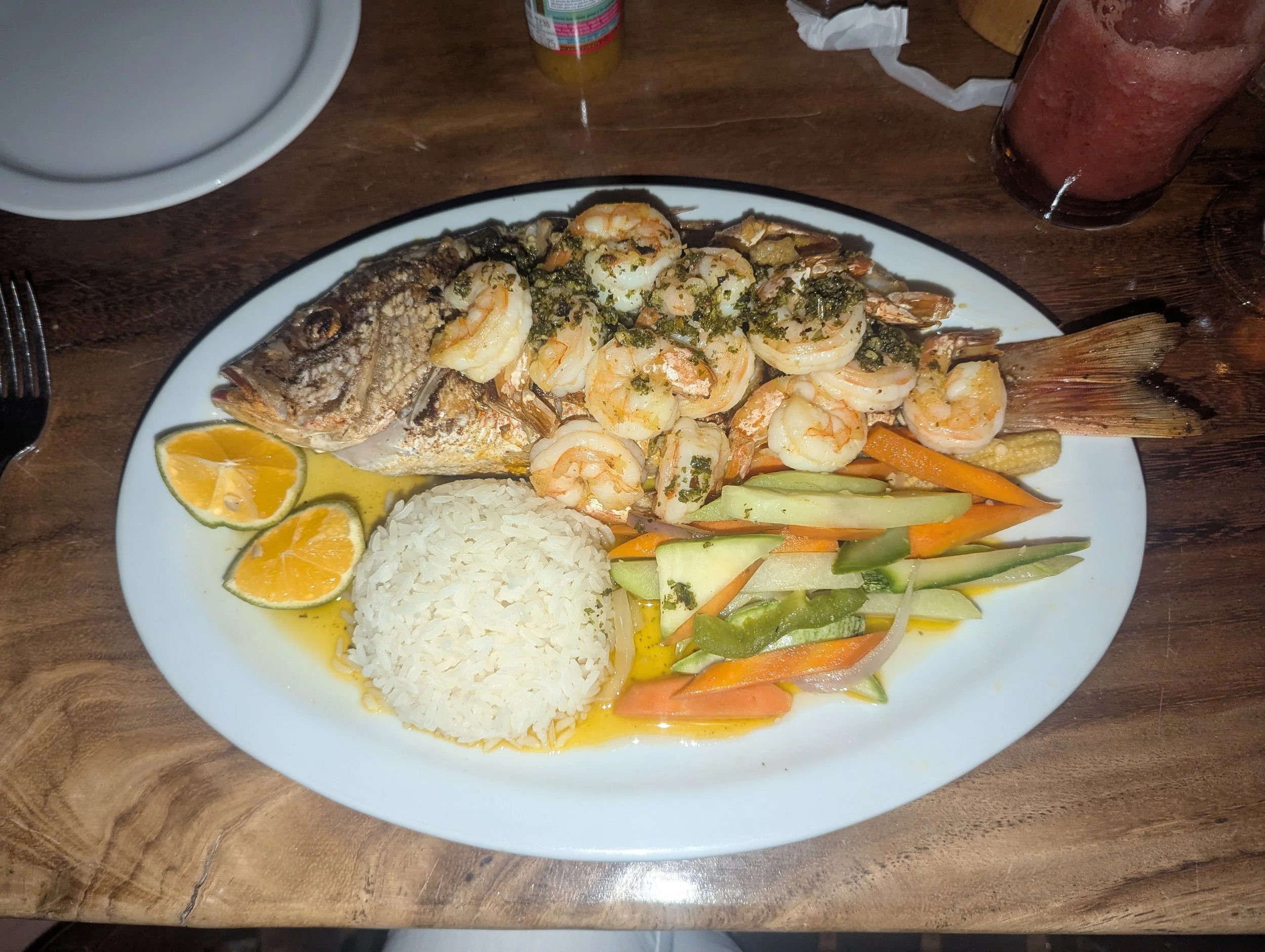
We went to dinner at El Avion at 6:30 PM, just a short, scenic walk from our hotel. Our stop at El Avion in the morning inspired us to dine here, and it had good reviews. It’s a cool concept - an actual plane in the middle of the restaurant that houses the bar. There’s another small plane that stands vertically and serves as a dumb waiter. They had a great variety of food, and the food was surprisingly good. I had a nightly special of grilled red snapper and garlic shrimp. The grilled red snapper was probably my favorite meal during the trip and perhaps one of my favorite (cooked) fish dishes ever. I still dream about it (this grilled snapper and the grilled mackerel in Japan). It was cooked to perfection, crispy skin, flaky flesh - just delightful. And there was so much of it! They didn’t skimp on the shrimp either. I had a dozen garlic shrimp in addition to my entire fish. There was a garlic shrimp entree that came with 18 shrimp.

The town is incredibly walkable, with small hills here and there but nothing strenuous, and no sidewalks, but usually a walking path on the side of the road. I always felt safe as long as we stayed aware of traffic. We returned to the hotel around 8:30 PM, ending the night with another dip in the hot tub before showering and heading to bed by 9:50 PM.
It was a day filled with nature, adventure, and heartfelt memories—the perfect Manuel Antonio experience.
Day 6: Butterflies and ATVs
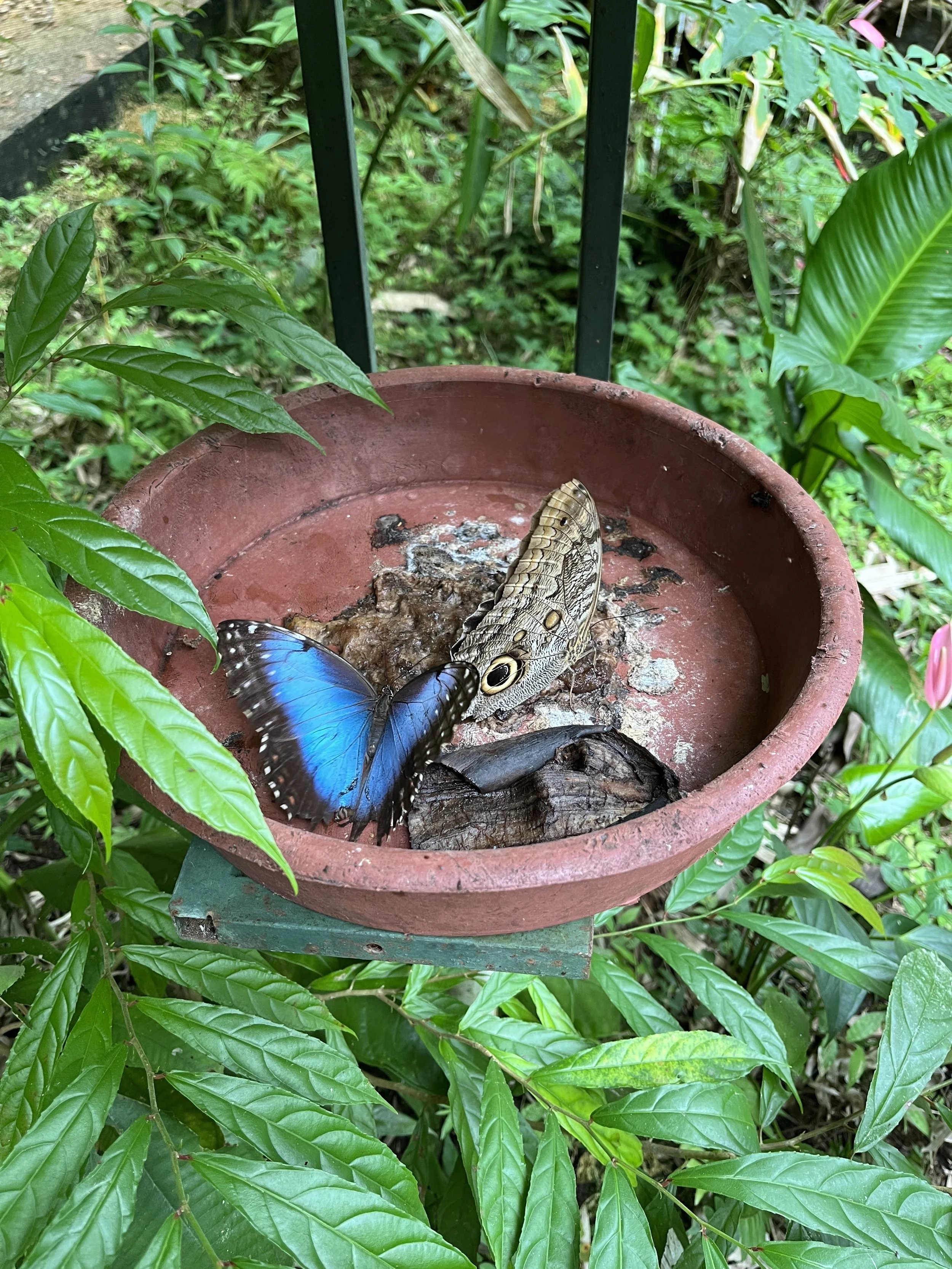
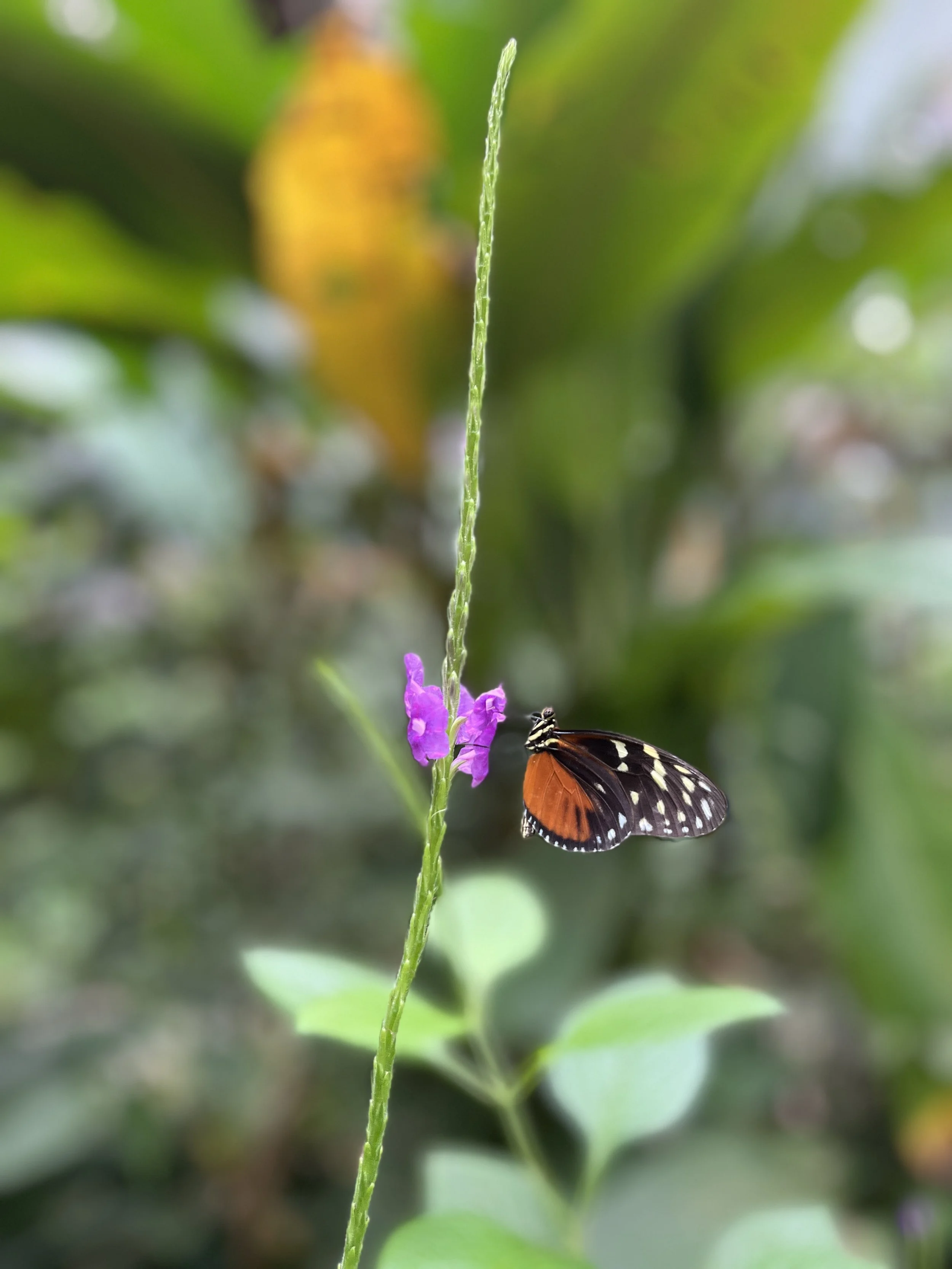
We woke up around 7 AM and headed to breakfast on site at 7:30. We enjoyed our meal and finished around 8:30. After breakfast, we took a leisurely walk down the street back to Sukia Park, to the butterfly garden, where Juan, one of our zipline guides from the day prior, was busy tending to the butterflies, caterpillars, and cocoons. We saw stunning blue morphos and owl eye butterflies fluttering gracefully and surrounding us, as well as a bunch of other species. The butterfly garden has a quaint cafe overlooking the garden, but for us, the highlight was spending time with Juan. Juan essentially gave us a private tour - he took time to explain how he cares for the butterflies. He looks for butterfly larvae and gently places them on plants held within enclosures, protected from predators. Once a cocoon develops, he pins them on a board, also enclosed, and checks them routinely to make sure there are no beetles or parasites. He identified one as we were listening to him that had black lines on it - these are beetles that would kill the butterfly growing within the cocoon and could spread to harm the others, so he tossed it on the ground behind him to feed the ants - a natural relationship in the ecosystem. Juan studies the butterflies that die to do research, and sometimes collects ones that have died for coworkers to create art. We spent way more time here than we anticipated, but we learned so much from Juan. It was so interesting to see this side of him that was so knowledgeable and compassionate; as a zipline guide, he was the jokester and had a good time. Nearby, caimans, crocodiles and turtles lounged in their enclosures. We saw at least ten caimans/crocodiles of varying sizes. The walkway hovers over some of the crocodile pens.



By 10 AM, we were back at the hotel to change for our ATV adventure. Our pick-up arrived at 10:25, and we reached the ATV site by 11:10. Lockers and bathrooms were available before the briefing. We geared up with bug spray and sunscreen, and helmets with visors, ready for the dusty ride ahead. We rode in pairs. Kevin drove first. We followed our guide, Carlos, on dirt roads that wind through acres and acres of a palm tree farm. We passed farmers harvesting palm fruits - they looked spikey, like durian, but red - with ox-drawn carriages.
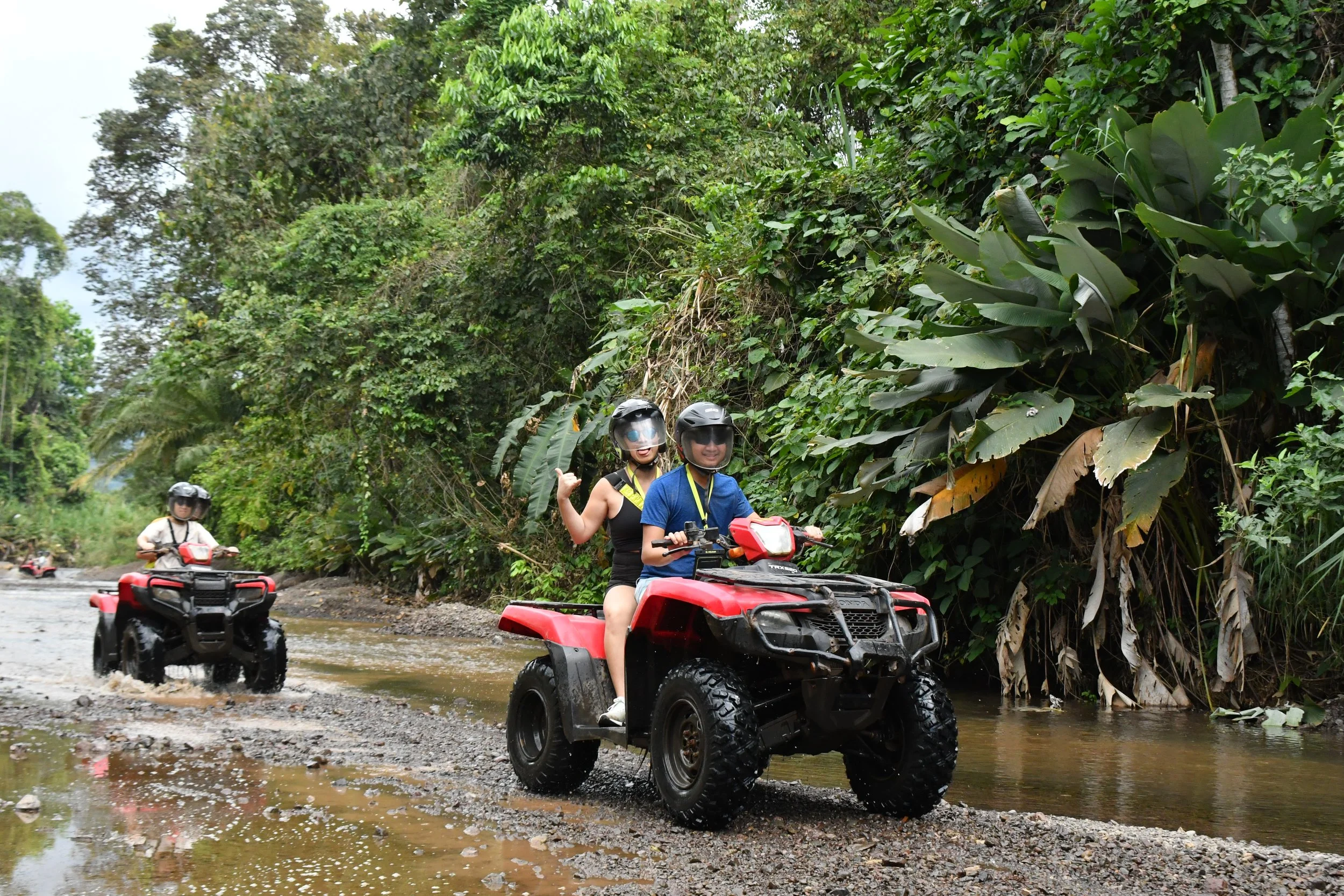
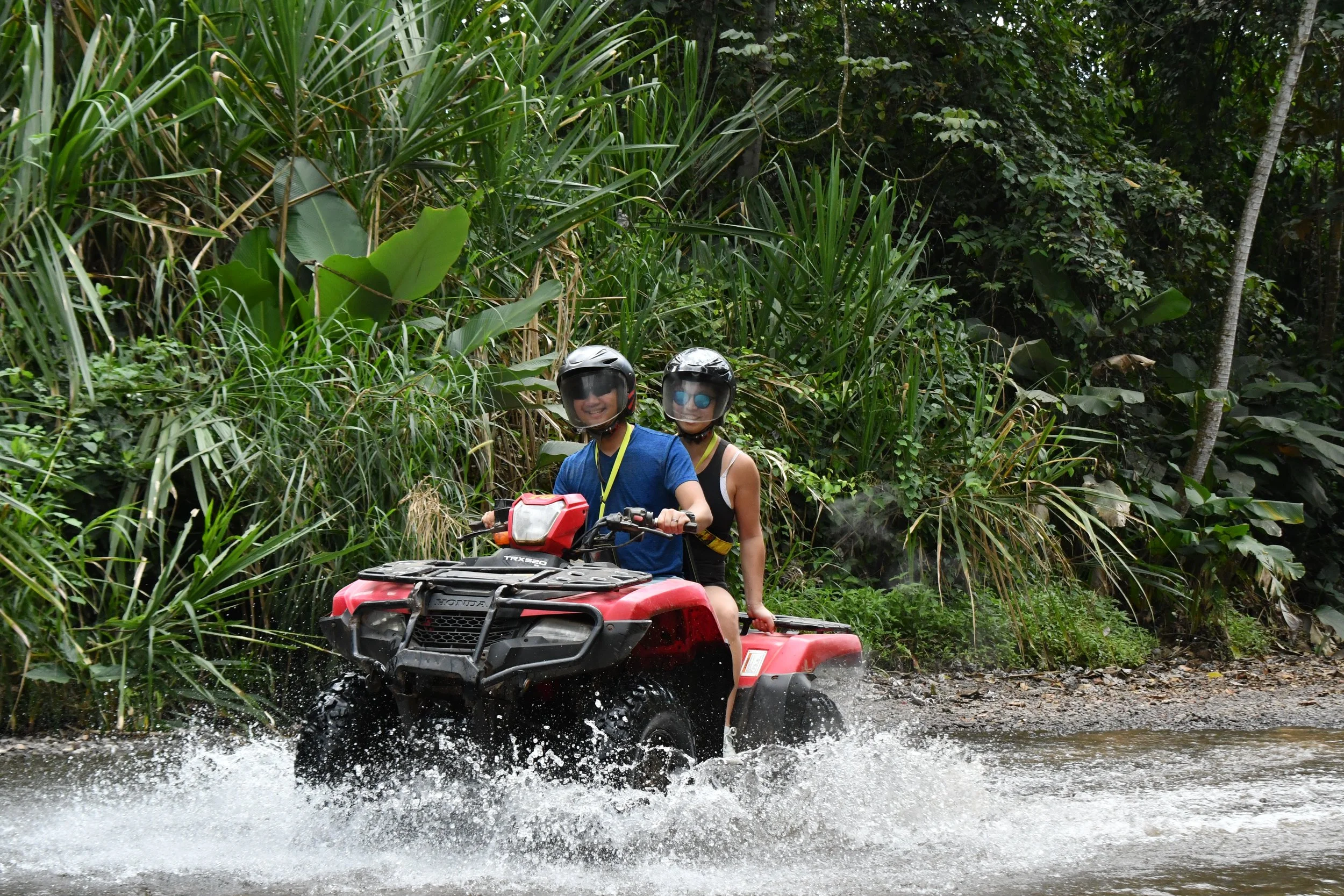
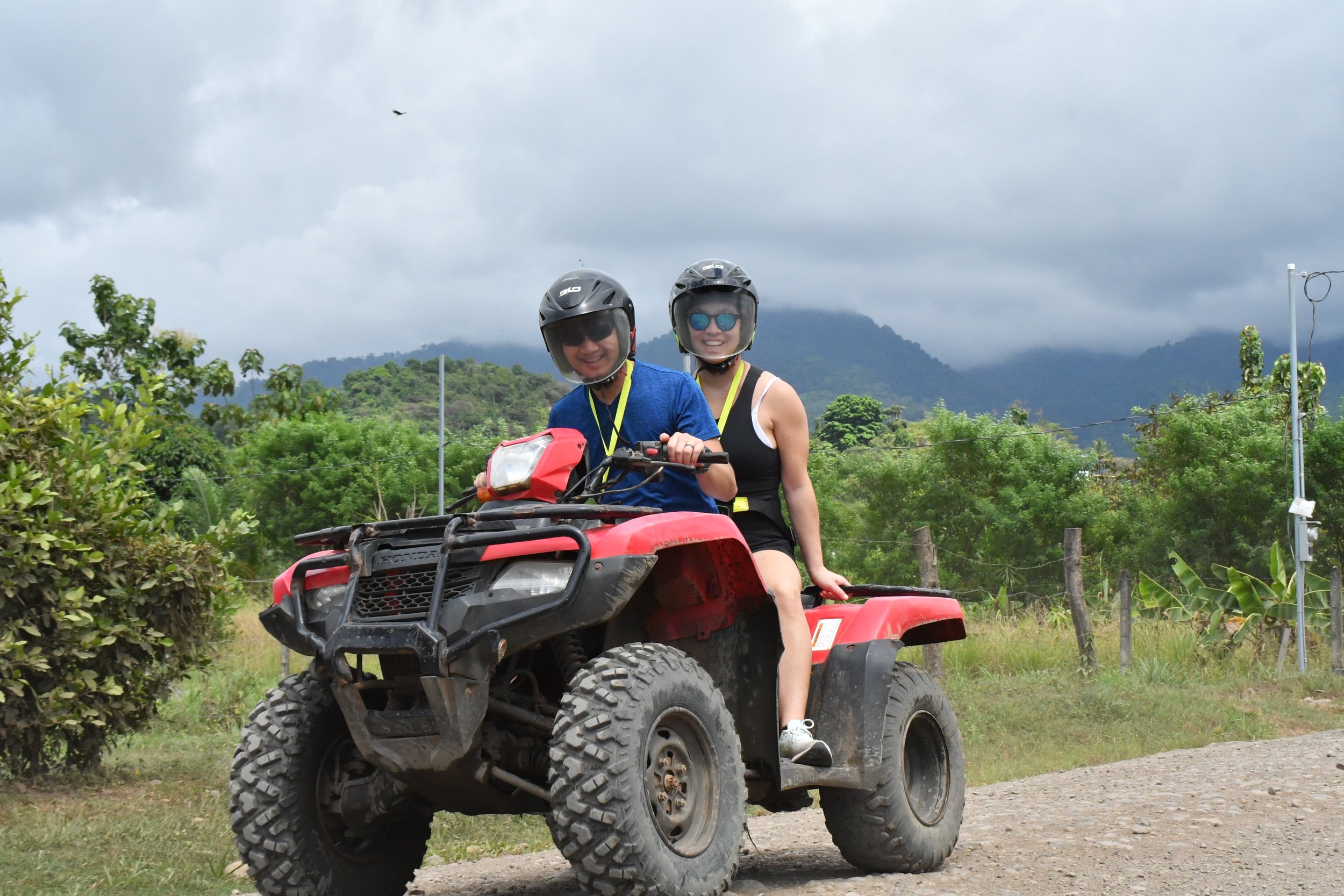
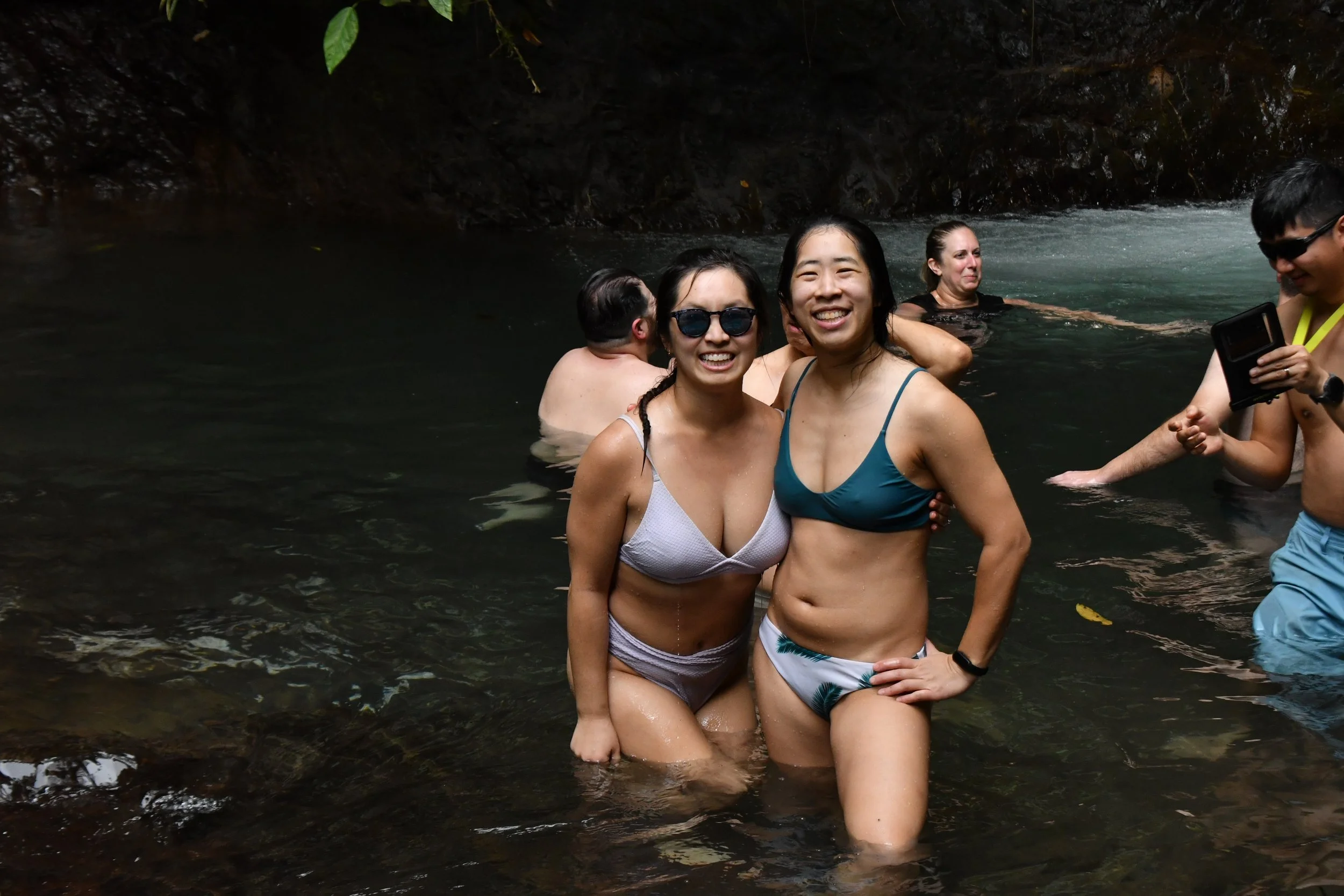
At 12:30, we arrived at Rainmaker, private property, where bathrooms and water were provided. The trails on property stretched 3.5 miles, taking about 1.5 to 2 hours to complete. We did just a short section of the trail. We hiked a quarter-mile in just 5-10 minutes to a refreshing swimming hole. After a quick dip, we were served fresh pineapple, a perfect tropical snack. By 1:30, we were back at the entrance of the private property and on our ATVs again.


Returning to ATV Home Base half an hour later, we had a satisfying lunch of rice (“Costa Rican fried rice” with shredded chicken and vegetables), beans, salad and plantains. This was one of the best rice dishes we had on the trip - in the middle of nowhere. After a half hour lunch break, we boarded the bus back to the hotel. Note to self: next time, bring a Buff—it was very dry and dusty.
On the way back, we passed the same palm farm we had ridden our ATVs through. Carlos told us that there are 200,000 acres of palm oil farms. The land is government-owned, with corporations paying concessions to operate. Trees are cycled every 20 years.
We got back to the hotel at 3:10 but spent at least 10 minutes struggling to get into our penthouse. The hotel had done elevator maintenance while we were away, and somehow every time we swiped our card, it opened 28A instead of 28B. Luckily, 28A belonged to the other half of our party, but we were not able to enter our side since the connecting doors weren’t operational. The elevator system was a bit unreliable, but we finally made it up by 3:30.

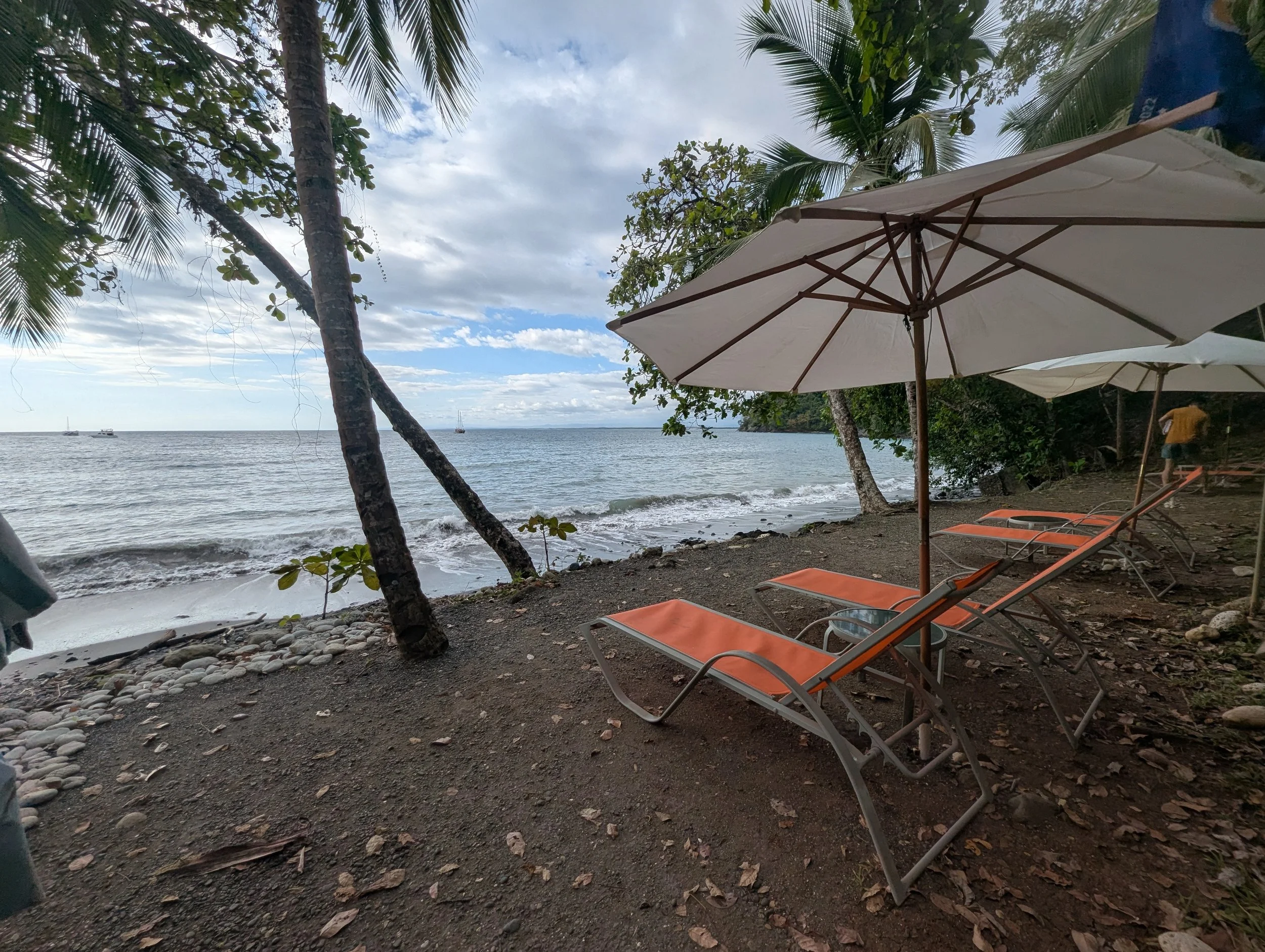

Selena wanted to go to the public beach, but the shuttle wouldn’t arrive for another hour. Our options were a taxi or the public bus, but after our previous taxi debacle, we decided to check out the private beach instead, especially since we hadn’t been (Selena and Chris had gone to the private beach the day prior). Selena opted for the pool and found my dad and Joanna there.
The private beach was a short, complimentary truck ride away. The road down was very steep, and I’m grateful we didn’t have to walk down. The path led to a small black sand beach with some lava rocks, but it was fine to walk barefoot. The water was warm, refreshing, and calm, with playful waves. We even spotted a pelican soaring overhead. No monkeys this time, as Selena and Chris had reported the day before. Ed and Susanne arrived just as we were leaving. They had to walk down since they missed the truck.
We called for a ride back at 4:30 and relaxed at the pool until 6:20. We discovered the hotel’s happy hour from 4 to 6 PM—certain drinks were 2 for $10, like pina coladas, margaritas, mojitos, guapirinhas - and smoothies were just $3. After showering and getting ready, we headed out for dinner at 7 PM at Emilio’s Cafe. I had Caribbean fish, while Kevin enjoyed grilled red snapper. We returned to the hotel by 8:45, wrapped up the evening with games of Overcooked and Codenames, and finally turned in for bed around 11 PM.


Day 7: Catamaran Snorkel and Sunset Soak
We woke up at 6 AM, feeling refreshed and ready for another adventure-filled day. We headed to breakfast at 6:45, where I enjoyed delicious French toast topped with homemade pineapple jam—a sweet, tropical start to the morning.
Our pickup arrived at 8:10 with Iguana Tours. Our guide, Allan, our captain, Carlos, and the cook (whose name I didn’t catch, but whose grilled chicken with passionfruit sauce turned out to be unforgettable) welcomed us aboard. The boat had a grill, and was loaded with all the water toys you could image, including a water slide!
From 9 to 10, we cruised along the serene waters, enjoying the picturesque cliffs from the sea. The contrast of the black volcanic cliffs and the blue Pacific water was stunning. It was a perfect morning with the sun shining. The boat tour includes six drinks per person, and the crew was very accommodating and ensured everyone had a drink in hand if they wanted one. In certain seasons, one could spot dolphins and whales. We weren’t so lucky this time around. I believe Carlos said that we were a month early for whales - so if that’s your goal, aim for February and March.


We found ourselves back in the cove near our private beach. Luckily, we were the only ones there, having left so early. Carlos said - and was right - that it would be teeming with other boats in 30-60 minutes. When we were on the private beach the afternoon before, there were at least four boats anchored in the distance. Once we anchored, the crew geared us up with snorkel equipment. Carlos led us to a rock, where we were able to spot vibrant marine life like Sergeant Major fish, parrot fish, damsel fish, and even sea urchins with impressively long spines. We enjoyed a hearty lunch around 11, savoring the flavorful chicken, fresh salad, and classic rice and beans. By 11:30, we were heading back to the marina, arriving around noon.
Back at the hotel by 12:20, we set out for a quick shopping trip to the local alcohol store, picking up coffee (Dota, recommended by Diego—though we later realized he actually meant Doka) and some rich Costa Rican chocolate. They make a 100% chocolate that we were curious to try. One of the things we hoped to do but cut from the itinerary due to time and cost was a coffee and chocolate tour.
At 1:30, we hit the pool, where we were treated to a surprise visit from a troop of monkeys, about 5-7 of them climbing up the tree onto the pool deck, terrorizing those who were enjoying their poolside lunch. Monkeys threw napkins off the tables, tried eating hot sauce although they couldn’t remove the cap from the jar, pushed chairs away from tables, threw the neatly rolled pool towel off the chaise lounge. Kevin, Chris and Craig were in the pool when the monkeys arrived, and two monkeys were drinking from the pool directly in front of Chris!

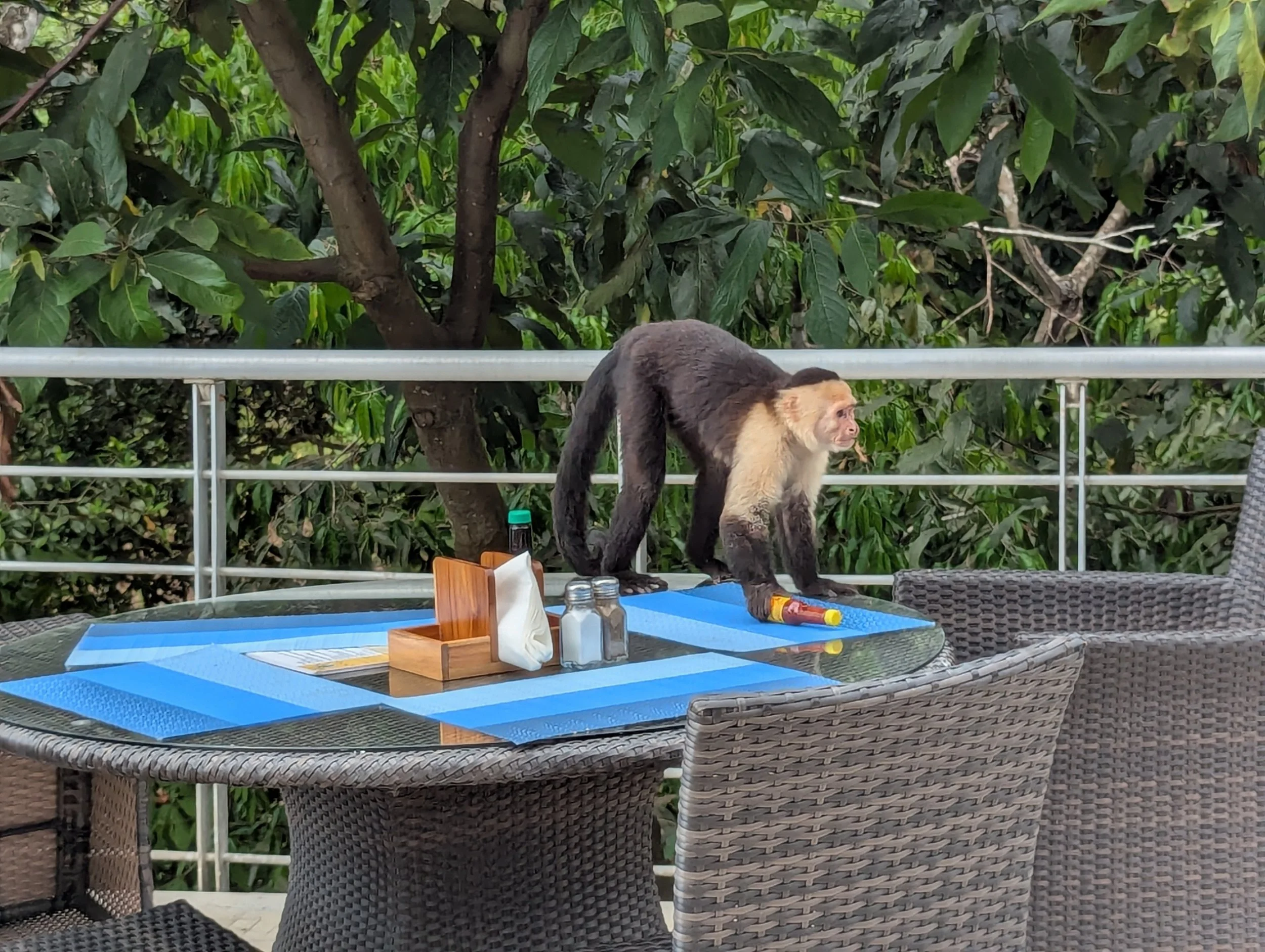
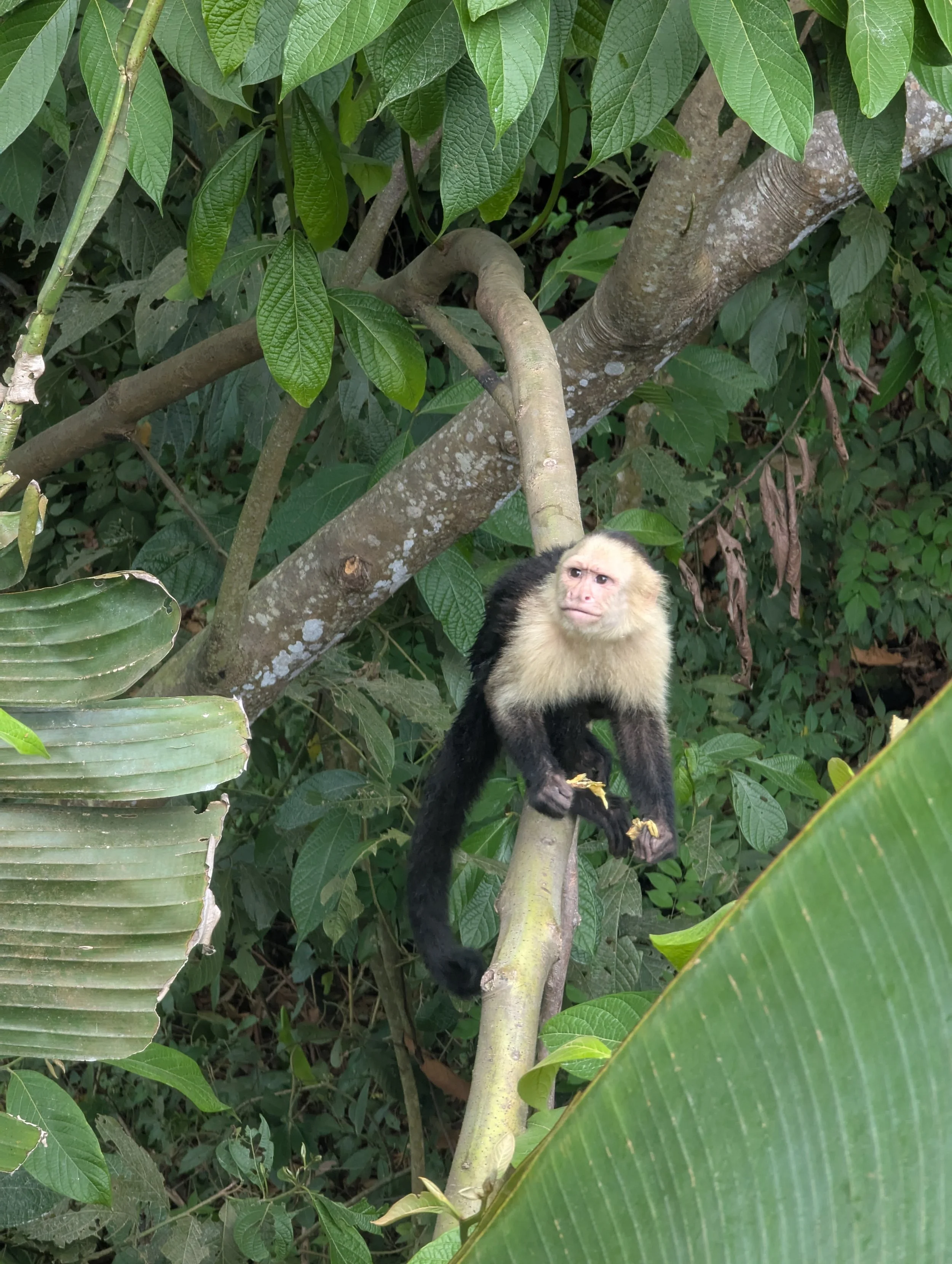
More from our group joined us at the pool as happy hour rolled around, and we admired the sunset from the pool.
After sunset, Kevin and I soaked in our private hot tub for fifteen relaxing minutes before showering and getting ready for dinner. We had reservations at Karolas, the restaurant on site, at 7 PM for the Costa Rican cultural show, complete with live music and traditional dancers—a vibrant, colorful display of local culture.
Back in our room around 9, we finished packing, and drifted off to sleep by 10:30, grateful for another incredible day in Costa Rica.
Day 8: The Journey Home
Our final day in Costa Rica began early. We had breakfast pre-arranged for pickup at reception at 6:45 AM. We were promptly picked up by Costa Rican Vacations at 7:00 AM, starting our journey back home.
Around 8:30 AM, we made a quick pit stop before continuing to the airport, where we arrived at 10:00 AM. After dropping off our bags and smoothly passing through security, we took some time to browse the airport shops. I had been hoping to purchase sloth socks. I first saw them at the gift shop at Mistico Hanging Bridges, but we were rushed and didn’t have time to purchase them. At that gift shop, they were buy two, get one free at $10 a piece. Every subsequent store got increasingly expensive. At the airport shops, we again saw the buy two, get one free promotion, except each pair was $23! Needless to say, I did not purchase socks.
At 11:10 AM, we settled into the VIP Santamaria Lounge outside of Gate 5 - thank you, Priority Pass! The lounge offered a variety of refreshments, including tamales, penne with meatballs, soup, banana cake, and fresh fruit. We also noticed many travelers enjoying glasses of wine, although we suspect at an additional charge. The outside temperature was a warm 78 degrees, a final reminder of Costa Rica's tropical charm.
We said our goodbyes to the group little by little as they left to board their flights. Our flight departed last, although only 45 minutes after our friends. By 1:45 PM, we were on board ready for departure, reflecting on our memorable adventure celebrating Ben and quality time with our family.
Concluding Thoughts
You do not need to worry about going hungry. All our meals had large portions. Rice and beans is a staple food and we ate it almost every day, but it is better than any rice and beans you’ll have here at home. I don’t particularly like rice and beans, but I did in Costa Rica.
Costa Rican pineapple is otherworldly.
While knowing Spanish isn’t essential, it certainly wouldn’t hurt. Almost everyone spoke English, but Spanish is, of course, the official language.
The La Fortuna area was more affordable than the Manuel Antonio area, in our experience.
I wish I brought water shoes - would have been nice for ATV-ing (my sneakers were drenched in mud) and going in the ocean, which was a little rocky at the shore, although not completely uncomfortable.
We were exceptionally lucky with weather. Being in the jungle and rainforest, it rains often. When we were in the rainforest, it rained at night mostly, with the one exception being when we were at La Fortuna waterfall. The other times it rained, we were conveniently at lunch or dinner, and the storm passed before we had to walk home.
We were pleasantly surprised that there were so few mosquitoes. I got a couple of bug bites, but considering we were living in the rainforest, we were expecting much much worse.
I really enjoyed Chachagua. It was the perfect combination of rustic and luxury. You didn’t just feel like you were in the rainforest, you were in the rainforest, but with creature comforts like air conditioning and a private pool.
This trip cost us just over $3,000 per person, not including flights or food (with the exception of breakfast, which was included in our accommodations) - for the transportation, accommodations and activities. Considering the caliber of accommodations at which we stayed, it was good value.
Costa Rica is a vibrant testament to sustainable living and natural beauty, seamlessly blending eco-conscious practices with authentic cultural experiences. Known for its commitment to environmental preservation, over 25% of the country is protected land, showcasing lush rainforests, diverse wildlife, and pristine beaches. Its dedication to renewable energy—often generating nearly 100% of its electricity from renewable sources—highlights a national ethos of sustainability. From eco-lodges that harmonize with nature to locally sourced cuisine and wildlife conservation efforts, Costa Rica offers an immersive, authentic experience rooted in respect for the environment and a pura vida spirit that celebrates simplicity, biodiversity, and connection.